1/14/2026
AI is already reshaping immigration practice, but the firms that win will be the ones that deploy it safely across intake, operations, and casework without compromising accuracy, confidentiality, or client trust.
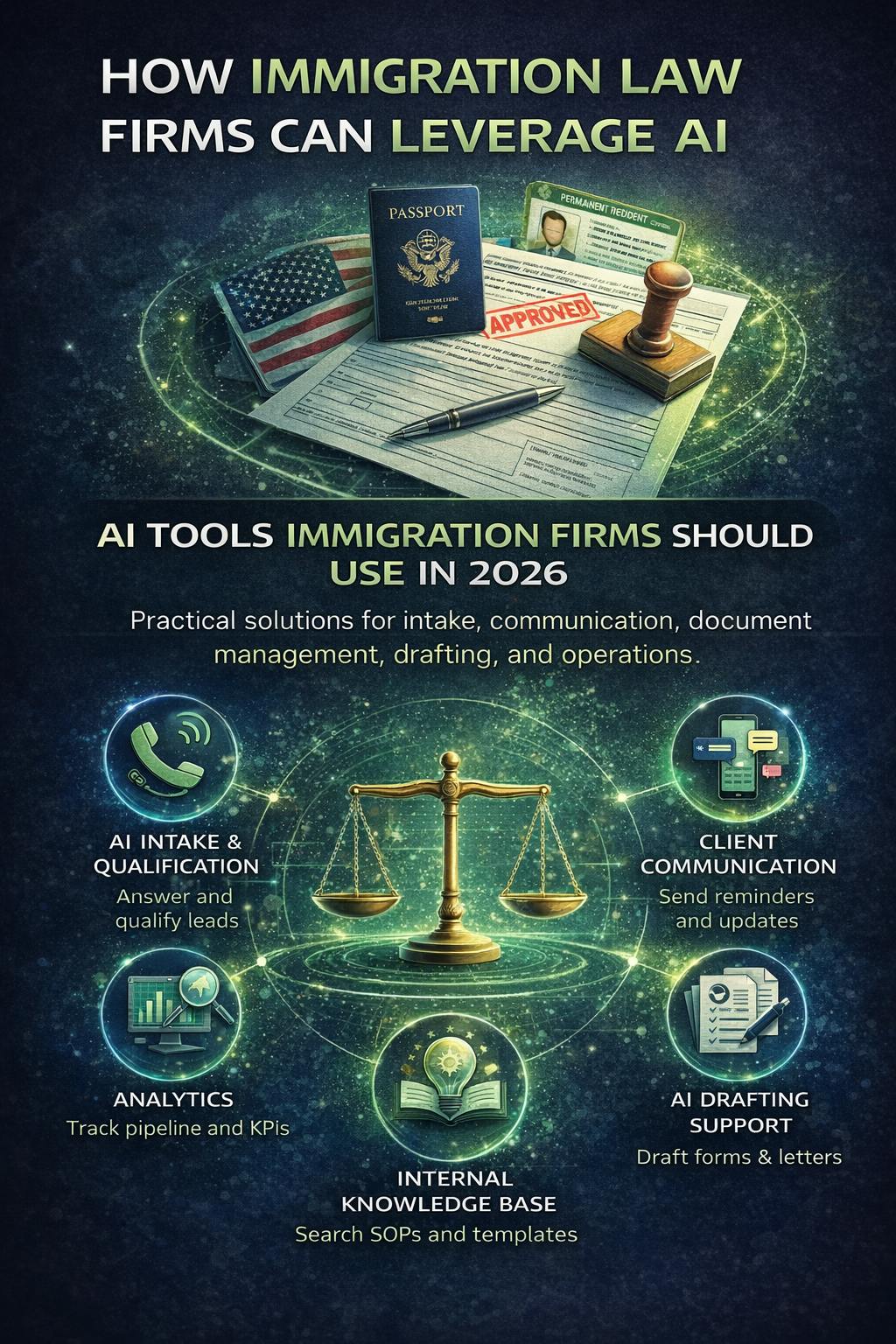
Immigration law is uniquely well-suited for thoughtful AI adoption because the work is high-volume, document-heavy, deadline-driven, and emotionally charged. Many matters follow repeatable pathways, yet each client also brings nuance: changing facts, mixed immigration histories, language barriers, and high stakes.
That combination matters.
In immigration, the goal is not simply to "use AI." The goal is to build a system where AI reduces friction, improves speed and consistency, and protects the client experience, while lawyers retain judgment and oversight. That broader framing connects directly to Why Intake Is More Than a Phone Function: It Is a Law Firm Growth System.
Immigration firms tend to face five recurring operational pain points:
These are exactly the kinds of problems where operational AI can help, especially when the firm uses it to strengthen intake, communication, document collection, internal workflows, and reporting.
That does not mean AI should replace legal reasoning. It means immigration firms have more repetitive, timing-sensitive, communication-heavy work at the front of the client journey than many other practice areas. That is why AI can be especially useful here when deployed with strong guardrails.
This same front-end challenge is also central to The Hidden Cost of Missed Calls: How Law Firms Lose Revenue Before Intake Even Begins, Legal Intake Is Broken - Here’s How to Fix It, and How to Build a Law Firm Intake Process That Actually Converts.
This is where many immigration firms quietly lose money.
Marketing, referrals, directories, and local visibility create demand, but missed calls, slow follow-up, or inconsistent screening can turn that demand into leakage. In immigrant communities especially, bilingual intake is not a nice-to-have. It is conversion infrastructure.
A stronger AI-supported intake layer can help firms:
That is why intake is usually the highest-leverage place to begin. It affects response speed, booked consultations, staff interruption levels, and lead conversion before substantive legal work even begins.
This is also the same broader scaling logic behind How AI Intake Helps Law Firms Scale Without Adding Overhead and How Modern Law Firms Scale Smarter with AI - Not Just More Staff.
Immigration clients want updates constantly. Many firms still handle this through inboxes, ad hoc calls, or staff spending hours repeating the same explanations.
AI can help support:
This is where AI can dramatically reduce repetitive staff work without stepping into legal advice. It should not answer legal strategy questions independently. But it can help provide structured, approved explanations and process updates that reduce confusion and keep matters moving.
That same principle appears in AI Legal Intake Process: 8 Expert Tips to Improve Your Law Firm’s Client Intake in 2026, especially the emphasis on speed, consistency, and better handoffs.
Immigration is evidence-driven. Some of the biggest delays do not come from legal complexity itself, but from disorganized documents, missing items, and unclear instructions.
AI can help by:
This is especially useful for family-based petitions, marriage-based cases, humanitarian matters, and employment-based cases with large evidence sets. The operational benefit is simple: the more structured the document workflow becomes, the less attorney and staff time gets wasted cleaning up preventable intake problems.
Drafting is where AI can save time, but it is also where firms can create real risk if they treat output as final.
High-value use cases include:
Best practice is to treat AI as a drafting associate, not an attorney. Everything still needs human review, especially anything going to USCIS, EOIR, or another official body.
This is one reason immigration firms should be especially disciplined about where they use AI. Drafting support can be powerful, but only when combined with review standards, templates, and attorney accountability.
Immigration teams move quickly, and new staff often need time to learn firm-specific processes, checklists, and workflows.
AI can help firms:
This works best when the firm maintains a clean internal knowledge base and keeps AI grounded in approved internal material. In other words, AI is most useful when it helps the firm operationalize what it already knows.
Many immigration firms do not have clean metrics, which makes staffing, intake, and growth more chaotic than they need to be.
AI can help support:
This is where AI becomes more than a productivity layer. It becomes a management tool.
That also connects naturally to The Law Firm Marketing Funnel: How to Turn More Leads Into Clients and PPC for Lawyers: How Law Firms Can Turn Paid Clicks Into Signed Cases, because better intake analytics help firms understand not just where leads come from, but which ones actually convert.
Most firms do not need a huge collection of disconnected tools. They need a coherent system.
A practical setup often includes:
The key is integration and governance, not tool sprawl.
Immigration law is high-stakes. AI use has to be disciplined.
At a minimum, firms should:
Done right, AI can improve consistency and documentation. Done poorly, it creates hidden risk. That is why governance matters just as much as the tool itself.
If a firm wants momentum without chaos, a practical phased approach works best.
That is the kind of operational sequence that makes AI useful rather than chaotic.
Immigration is one of the strongest examples of why modern law firms need both strong visibility and strong intake.
Potential clients often discover firms through referrals, Google, directories, ethnic-community networks, and increasingly through AI-driven search and answer engines. But if the first response is weak, slow, English-only, or poorly structured, the opportunity may be lost immediately.
That is why this topic also connects naturally to Why Immigration Law Firms Are Experiencing Heavy Phone Call Volumes in 2026 and How ChatGPT and AI Search Engines Understand Your Law Firm’s Website (And How to Optimize).
Clerx helps immigration firms modernize one of the highest-leverage parts of the journey: intake and communication.
That means helping firms strengthen first response across calls, website chat, and SMS, capture structured intake data, support multilingual communication, book consultations, and follow up with leads that do not convert the first time.
The goal is not automation for its own sake. It is consistent responsiveness and cleaner data capture at the front of the client journey.
Clerx also integrates with tools many firms already use, including MyCase, Clio, Lawmatics, Filevine, PracticePanther, and Smokeball. Firms can also browse the full Clerx integrations page.
For related intake strategy, these posts may also help:
Immigration firms do not win by adopting the most AI. They win by building the most reliable system: fast response, bilingual access, structured intake, disciplined drafting, and consistent follow-up.
AI is not a replacement for legal judgment. It is the operational layer that makes judgment more scalable.
If you want to see what a resilient, AI-enabled intake system can look like inside your firm, book a demo with Clerx here: https://www.clerx.ai/book-a-demo
Because immigration work is high-volume, document-heavy, deadline-driven, multilingual, and emotionally charged. Those features make structured intake, communication, and workflow support especially valuable.
Strong use cases include intake responsiveness, multilingual communication, document collection, process management, client updates, and operational analytics.
Usually intake and lead conversion. Faster response, bilingual access, better qualification, and structured data capture often create the fastest operational and financial impact.
Yes. AI can support process updates, reminders, next-step communication, and multilingual templates, as long as legal advice and legal conclusions remain human-led.
Yes. AI can support document checklists, labeling, missing-item detection, and plain-language upload instructions, which can reduce delays and improve evidence organization.
It can help with first drafts, outlines, and structured drafting support, but everything should go through human review, especially anything submitted to USCIS or EOIR.
Legal advice, strategic decisions, final drafting review, filings, and client-facing legal conclusions should remain human-led.
Yes. AI can help search internal checklists, SOPs, templates, and playbooks, which can improve training and standardization.
Because prospective clients may call, use website chat, or prefer text-based communication. Immigration firms often also need bilingual or multilingual coverage, which makes stronger front-end communication especially important.
Start with intake leakage. Strengthen first response, qualification, bilingual communication, and booked-consultation flow before expanding into other AI use cases
6/12/2026
Text messaging can improve speed and convenience, but only if the firm treats SMS as part of intake instead of a disconnected side channel.
6/11/2026
Website chat can improve law firm conversions, but only when it helps visitors move forward instead of adding another disconnected intake step.
We use cookies to ensure you get the best experience on our website. For more information, please see our Privacy Policy.
