5/25/2026
In family law, empathy and timing are everything - here’s how automation can help your firm deliver both while saving time and boosting client satisfaction.
By Attorney Michael Brunman, Co-Founder & CEO of Clerx
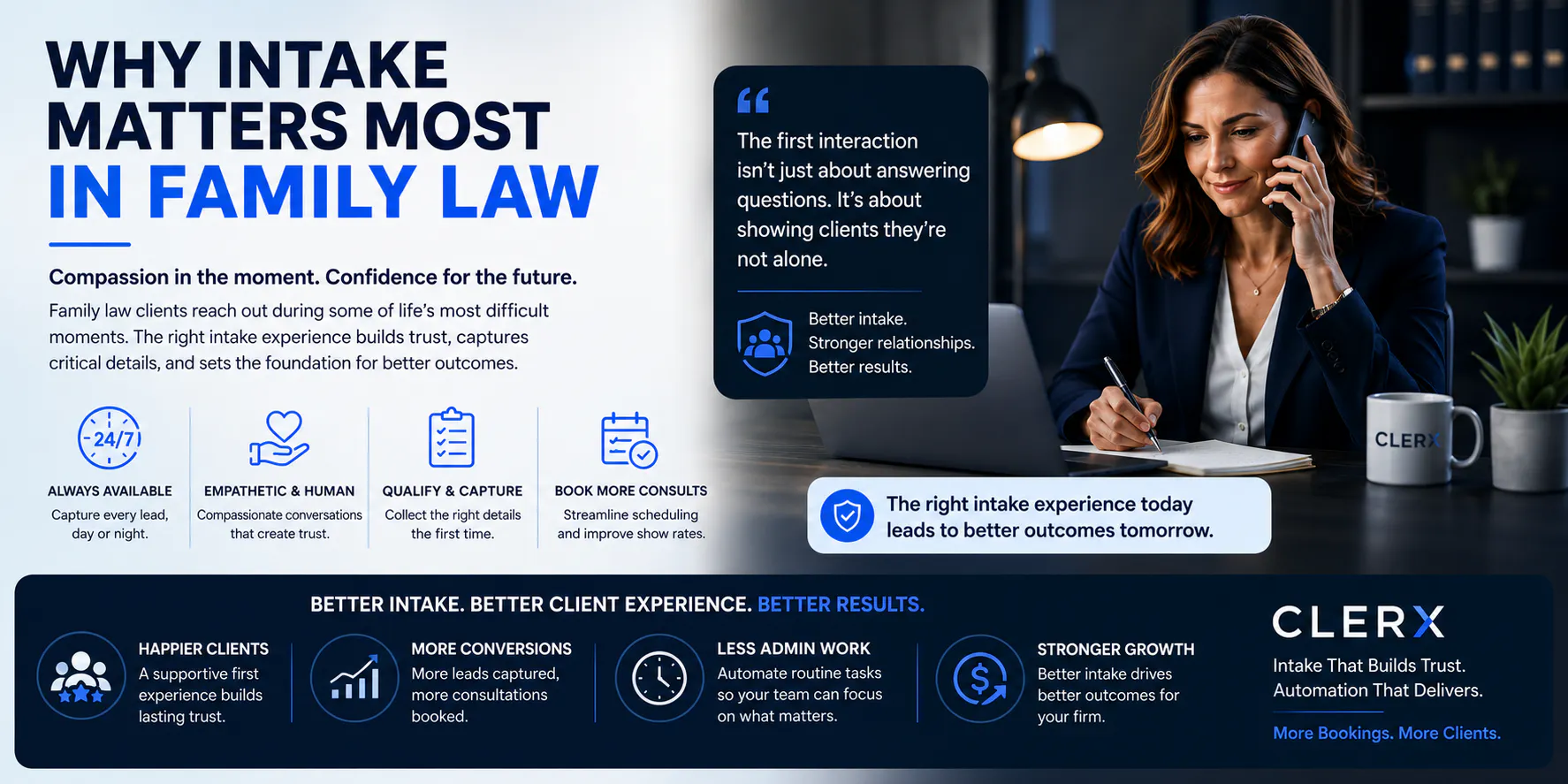
Family law clients often reach out in moments of deep emotion. They may be facing divorce, custody issues, adoption questions, domestic conflict, or an urgent hearing. In those moments, they are not just looking for a lawyer. They are looking for reassurance, clarity, and a sense that someone understands what they are going through.
That is why intake is not just an administrative step in family law. It is the beginning of trust. The way your firm answers a call or responds to a website inquiry shapes whether a potential client feels supported or decides to keep searching. This same broader point runs through Why Intake Is More Than a Phone Function: It Is a Law Firm Growth System, Mastering Law Firm Intake in 2025: Turn First Calls Into Clients, and The Complete Guide to Perfecting Law Firm Intake in 2026.
Unfortunately, many firms still lose strong leads because intake is handled inconsistently, delayed, or without enough empathy. That same front-end leakage problem is at the center of The Hidden Cost of Missed Calls: How Law Firms Lose Revenue Before Intake Even Begins, The After-Hours Gap: Why Law Firms Lose Clients After 5 PM (and How to Fix It), and Why Law Firms Get Ghosted and How to Fix It.
Family law clients usually call when life already feels unstable. They may be scared, overwhelmed, embarrassed, angry, or unsure how to describe what is happening. That means the first interaction has to do more than move efficiently. It has to make the caller feel safe enough to continue.
This is why family-law intake is fundamentally different from intake in less emotionally charged practices. The same practice-specific point is explored in How Family Law Firms Can Use AI to Improve Intake, Responsiveness, and Client Trust.
When someone is facing a divorce, custody dispute, or restraining-order issue, they usually do not want to leave a voicemail and hope someone calls back.
A stronger intake system answers immediately, even when the office is closed or the team is busy. That is why modern firms are moving beyond voicemail-dependent workflows toward systems that protect first response more intentionally, as discussed in Legal Answering Services in 2026: Which Option Is Right for Your Practice?, Why Attorney Offices Are Moving From Virtual Receptionists to AI Intake, and Why More Law Firms Are Upgrading From Virtual Receptionists to AI in 2025.
A strong first-response flow should be able to capture basics like:
In family law, tone matters as much as timing.
A caller may remember the emotional feel of the first conversation long after they forget the exact words. If the intake process feels cold, rushed, or overly mechanical, trust can drop fast. If it feels calm, clear, and respectful, the firm immediately stands out.
That is why communication quality matters so much in The Hidden Cost of Poor Communication for Small & Midsize Law Firms, Why Better Client Communication Is One of the Biggest Growth Levers for Law Firms, and Why Client Perception Doesn’t Match Lawyer Intention - And What Firms Can Do About It.
A good family-law intake process should give attorneys enough context to assess fit and prepare for the consultation without overwhelming the client.
Important details often include:
That kind of structured qualification is exactly why better intake improves both conversion and attorney efficiency, a theme also reflected in Stop Wasting Time: How Smart Law Firms Qualify Better Leads in 2025, The Law Firm Marketing Funnel: How to Turn More Leads Into Clients, and How Small and Midsize Law Firms Can Balance Lead Generation and Operational Efficiency for Sustainable Growth.
The strongest family-law intake systems do not use automation to remove empathy. They use it to make empathy more consistent.
Family-law clients do not always call during neat office hours. They may reach out late at night, on weekends, or in the middle of a conflict. A stronger intake layer protects those moments instead of letting them disappear into silence.
That same after-hours problem is why Clerx repeatedly ties intake quality to responsiveness in The Hidden Cost of Missed Calls: How Law Firms Lose Revenue Before Intake Even Begins, The After-Hours Gap: Why Law Firms Lose Clients After 5 PM (and How to Fix It), and Why AI Intake Is the New Standard for High-Performing Law Firms.
Not every family-law prospect books right away. Some hesitate because they are comparing firms, emotionally overwhelmed, or unsure about the next step. That is where structured follow-up matters.
Instead of relying on someone to remember every callback or text, stronger systems build follow-up into the workflow itself. That same conversion issue is central to Why Law Firms Get Ghosted and How to Fix It, Why AI Intake Specialists Are Becoming a Law Firm’s Super Power, and How AI Intake Helps Law Firms Scale Without Adding Overhead.
Many family-law prospects prefer to start with a chat rather than a phone call, especially when discussing personal matters. A strong website-chat experience can collect basic information, answer first questions, and make booking easier while still reflecting the firm’s tone.
That is one reason modern intake is increasingly understood as a cross-channel system across calls, website chat, and SMS, not just a person answering the phone.
Family-law matters involve sensitive personal, financial, and parenting information. That means intake cannot just be fast. It also has to be secure, organized, and controlled.
When firms centralize intake and communication into stronger systems, they reduce duplication, improve handoff, and make it easier for the legal team to enter each consultation prepared. This same operational benefit is reinforced in The Hidden Cost of Disorganized Intake, You’re Not Too Busy. Your System Is Too Manual., and Understanding Law Firm Burnout: The Silent Crisis.
Automating intake is not only about moving faster. It is about creating a more sustainable way to grow.
Stronger family-law intake usually leads to:
That same growth-without-chaos logic is reflected in How AI Intake Helps Law Firms Scale Without Adding Overhead, Why AI Operations Layers Are Becoming Essential for Law Firms in 2025, and Systems Make the Firm. Not Hustle..
The most successful family-law firms do not choose between empathy and efficiency. They build systems that support both.
That is why better intake becomes such a competitive advantage. It helps the firm sound more organized, feel more responsive, and create stronger trust earlier. This same broader theme appears in Why Better Client Communication Is the Real Driver of Legal Tech Adoption, Why Better Client Communication Is One of the Most Overlooked Growth Levers for Law Firms, and Why Better Client Communication Is One of the Biggest Growth Levers for Law Firms.
Clerx helps family-law firms strengthen intake and communication across calls, website chat, and SMS so no opportunity is lost because the firm was slow, inconsistent, or unavailable.
For firms that want to review workflow fit first, start with 8am MyCase, then Clio, then the broader Clerx integrations page, where Smokeball appears in the Clerx ecosystem, followed by Lawmatics and Lawcus.
Those integrations matter because intake works best when the information does not live in a silo. Practice-management-specific Clerx content reinforces that point in Can MyCase Automate Client Communication? What Law Firms Should Automate - and What Still Needs an Intake Layer, The Intake Layer: How Lawcus Users Turn More Leads Into Matters, and The Intake Layer: How Filevine Users Turn More Leads Into Matters.
In 2025, family-law clients expect empathy, clarity, and immediate support. A modern intake process delivers all three by making sure no call goes unanswered, no lead sits too long, and no client feels ignored at the moment they most need reassurance.
That is why intake matters so much in family law. It is not just about efficiency. It is about trust, client experience, and growth.
If you want to modernize your family-law intake process, book a demo here:
Because family-law clients often reach out during emotionally intense moments. The speed, tone, and clarity of the first response strongly influence whether they feel safe enough to move forward.
At minimum, it should capture the type of matter, urgency, whether there are hearings or deadlines, the parties involved, and enough context for the attorney to assess fit.
Common reasons include missed calls, slow follow-up, inconsistent tone, poor qualification, and too much friction between first contact and consultation.
Because family-law intake depends heavily on responsiveness, empathy, consistency, and better follow-up. AI helps firms support those moments without creating more front-end chaos.
Not when it is implemented well. The strongest use case is making the first interaction more dependable and compassionate while protecting attorney time for the most sensitive human parts of the representation.
Because firms do not want intake details, scheduling actions, and follow-up activity living in separate systems. They want early client data to move directly into the tools they already use.
Start with 8am MyCase, Clio, then the broader Clerx integrations page, where Smokeball appears in the ecosystem, followed by Lawmatics and Lawcus.
Clerx helps strengthen intake and communication across calls, website chat, and SMS so firms can respond faster, build trust earlier, reduce missed opportunities, and move more qualified prospects toward consultation.
Attorney Michael Brunman, is the Co-Founder and CEO of Clerx. He is a former commercial and intellectual property litigator, Harvard MBA ’23, former PayPal product manager, and former McKinsey consultant. At Clerx, he helps law firms use AI agents to improve client intake, reduce missed calls, and streamline client communication.
6/12/2026
Text messaging can improve speed and convenience, but only if the firm treats SMS as part of intake instead of a disconnected side channel.
6/11/2026
Website chat can improve law firm conversions, but only when it helps visitors move forward instead of adding another disconnected intake step.
We use cookies to ensure you get the best experience on our website. For more information, please see our Privacy Policy.
