3/30/2026
Every missed call is more than a missed conversation. For many law firms, it is a missed client, a missed case fee, and a hidden leak in the growth engine.
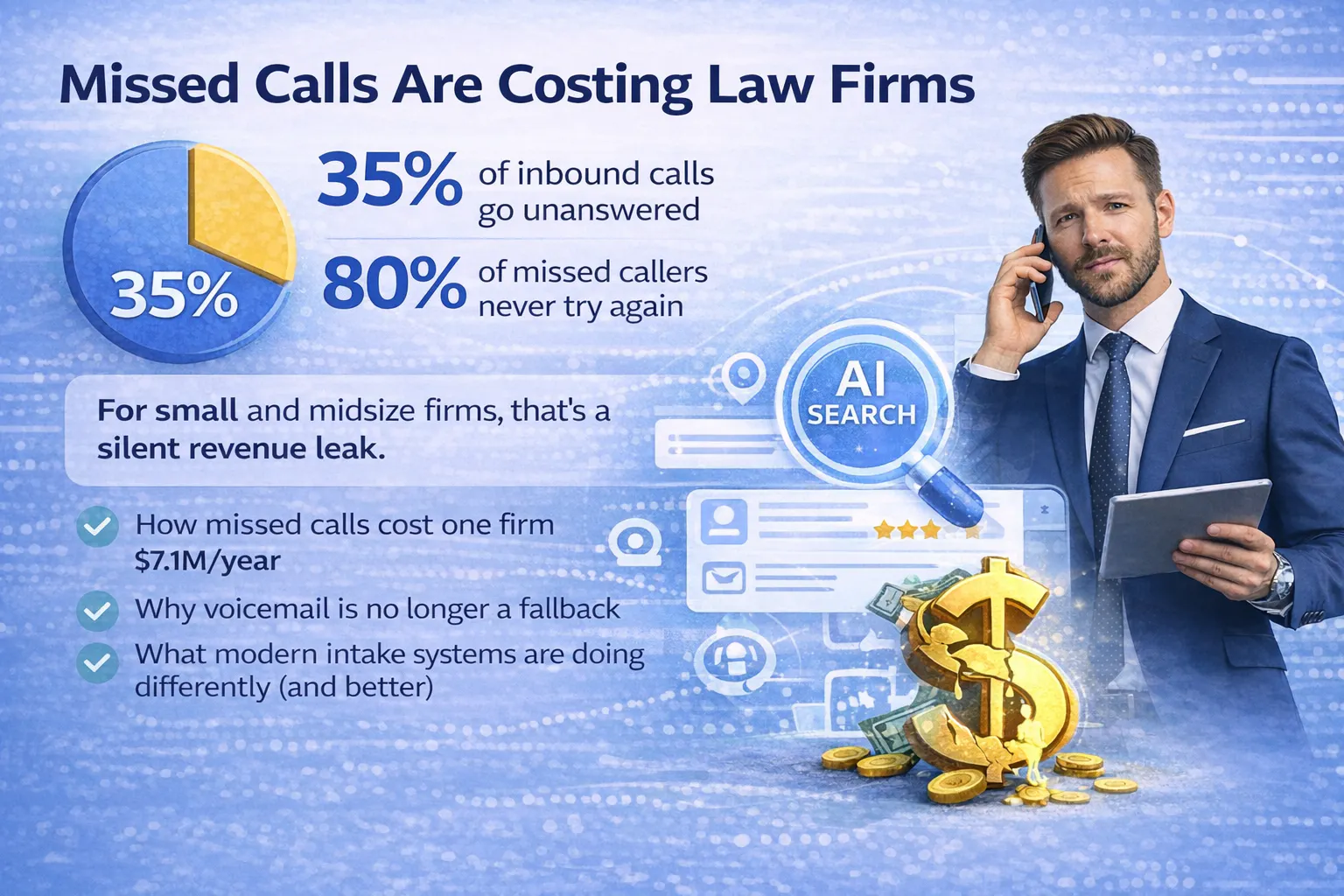
Most law firms do not think of missed calls as a major financial problem.
They think of them as an inconvenience.
A receptionist was busy.
A lawyer was in court.
The team planned to call back later.
A voicemail probably captured the inquiry.
But that is not how prospective clients experience the moment.
For the person calling, that missed call may be the most important thing happening in their day. They may have just been injured in a crash, received immigration news that frightened them, learned of a family emergency, or reached a point where they are finally ready to hire a lawyer after weeks of hesitation.
When that call goes unanswered, the opportunity often disappears immediately.
That is why missed calls are not just a communication issue. They are a revenue issue, a conversion issue, and a growth issue.
For many firms, especially in competitive consumer-facing practice areas, the intake breakdown caused by missed calls can quietly cost hundreds of thousands or even millions of dollars over time.
Many law firm owners underestimate what happens after a missed call.
They assume the caller will leave a voicemail.
They assume the staff can return the call later.
They assume a qualified lead will stay patient.
But in practice, many callers do none of those things.
The numbers in your earlier draft tell the story clearly:
Whether the exact percentages vary by practice area, the underlying point is clear: legal consumers are often acting with urgency, and delayed response has a real cost.
A missed call is rarely just a missed ring.
It is often the moment a prospective client decides whether your firm is responsive, trustworthy, and available.
This problem becomes much more serious when you connect it to actual case value.
Take a firm that generates 80 new inquiries per month.
If the firm misses roughly one out of every three calls, a meaningful share of potential clients may never make it into the intake process at all.
And if those missed opportunities include high-value matters, the financial consequences can become very large very quickly.
That is why missed calls should not be measured only by call volume. They should be measured by downstream revenue impact:
A firm can spend heavily on SEO, paid ads, referrals, directory placements, and social media, only to lose the return on that investment because nobody answered the phone.
In that sense, missed calls are often not an isolated intake problem. They are a breakdown in the entire client acquisition system.
For many law firms, the most dangerous missed calls happen outside normal business hours.
That is when staffing is thin, response times are slow, and voicemail becomes the default.
It is also when many high-intent legal inquiries happen.
A personal injury prospect may call in the evening after getting home from the hospital.
A family law caller may reach out late at night after a domestic crisis.
An immigration client may call outside business hours because they are juggling work, childcare, and stress.
A criminal defense or urgent employment caller may want immediate reassurance before deciding whether to share sensitive details.
When those people reach voicemail, many will not wait until the next morning.
They will call another firm.
That means after-hours coverage is not just a convenience feature. In many practices, it is one of the highest-leverage parts of intake.
For years, many firms treated voicemail as an acceptable fallback.
That no longer reflects how people behave.
Today’s legal consumer expects speed, clarity, and acknowledgment. They are used to getting immediate responses from nearly every service business they interact with. That expectation does not disappear when they call a law firm. If anything, it becomes stronger because the stakes are higher.
Voicemail creates several problems at once:
The caller has to explain their issue without knowing whether anyone will listen soon.
An unanswered call can make a firm feel unavailable or disorganized.
Even if the firm calls back later, the emotional urgency of the moment is gone.
By the time the callback happens, the prospect may already be speaking with another firm.
This is why voicemail is often not neutral. It is a conversion leak.
A lot of firms think the solution is simply answering more calls.
That is part of the answer, but not the full answer.
The deeper issue is intake continuity.
What should happen from the moment a prospective client reaches out until the moment the right next step is secured?
A strong intake process does not just answer the phone. It does several things well:
This is where many firms struggle.
Even when a call is answered, the intake may still be weak:
That means the real opportunity is not only fewer missed calls. It is stronger intake from first contact onward.
The financial impact of missed calls is especially severe in practice areas where:
Personal injury is the clearest example.
A firm may spend heavily to generate traffic and calls. But if those calls are missed, the problem is not just lost communication. It is wasted acquisition spend plus lost case revenue.
The same logic applies, in different ways, to other consumer-facing practices like immigration, family law, workers' compensation, bankruptcy, plaintiff-side employment, disability, and criminal defense.
In all of these practices, missed calls often happen at the exact point where the prospect is most motivated to take action.
That is why improving response speed can sometimes create more growth than adding more marketing spend.
Many lawyers assume clients choose the best lawyer.
In reality, many legal consumers first choose the lawyer who felt available, responsive, and easy to engage.
That does not mean expertise does not matter. It does.
But before a client can evaluate legal quality, they need a real first interaction.
If one firm answers immediately, asks the right questions, and helps the caller move forward, while another sends the caller to voicemail, the first firm often wins the opportunity.
This is especially true for smaller firms competing against better-known firms with larger budgets.
Speed and structure can outperform brand size when the first-response experience is strong.
The firms solving this problem are not simply hiring more people and hoping for the best.
They are redesigning intake around responsiveness and consistency.
That usually includes some combination of the following:
Firms are moving away from the idea that intake ends when the office closes.
They make sure the first interaction captures usable information instead of random notes.
They reduce lag between first contact and next step.
They do not let warm inquiries cool off.
They track missed calls, response times, booking rates, and lead-to-client conversion.
The common theme is not just automation.
It is operational discipline.
AI is becoming useful in law firm intake not because it replaces lawyers, but because it helps firms handle repetitive front-end communication more reliably.
Used correctly, AI can support the moments that most often break under pressure:
At Clerx, this is exactly where Donna fits.
Donna serves as an AI receptionist that can answer inbound calls, collect structured intake information, and help firms avoid losing prospects to silence or delay.
Website chat can support prospects who prefer written interaction.
For follow-up outreach, outbound calls can be handled by Jeremy, helping reduce drop-off between inquiry and consultation.
The point is not to automate legal advice. It is to make sure real opportunities are not lost before the legal work even begins.
This part matters.
Law firms should absolutely strengthen intake with systems and automation. But they should not hand over legal judgment.
Do not automate legal advice.
Do not automate case strategy.
Do not automate final fit decisions without attorney oversight.
Do not automate sensitive conclusions that require professional review.
The goal is not to replace the firm.
The goal is to make the firm more responsive, more organized, and more consistent at first contact.
Firms do not need a massive transformation to improve this.
A focused 30-day plan can create meaningful progress.
Start by tracking:
Most firms are surprised by what they find.
Define the minimum information that should always be captured:
Decide what happens when staff is unavailable.
This may include:
Build a consistent next-step process:
This is how intake becomes a system rather than a scramble.
If your firm wants to improve missed-call performance, focus on a short list of metrics:
These numbers reveal whether your intake process is protecting or leaking revenue.
Without them, missed-call problems stay invisible for too long.
Many law firms invest heavily in getting the phone to ring.
Far fewer invest with the same seriousness in what happens when it does.
That is why missed calls are so expensive.
They are not just lost conversations. They are lost momentum, lost trust, wasted marketing spend, and lost matters that may never come back.
For firms that want more predictable growth, reducing missed-call leakage is one of the most practical places to start.
Because before a firm can win the work, it has to capture the opportunity.
Because many legal consumers call when they are ready to act. If the call goes unanswered, they often move on to another firm rather than waiting for a callback.
Not always. Many prospective clients do not leave voicemails, especially when they feel urgency or uncertainty.
Yes. Many urgent legal inquiries happen outside standard office hours, especially in consumer-facing practice areas.
Not entirely. Staffing matters, but the larger issue is intake design. Firms need a system for first response, qualification, scheduling, and follow-up.
AI can answer calls immediately, collect structured intake details, support qualification, and help route prospects toward the right next step.
Clerx acts as an AI intake and communication layer. Donna handles inbound calls, website chat helps capture online inquiries, and Jeremy supports outbound follow-up where needed.
If your firm is generating calls but still losing inquiries to voicemail, delay, or inconsistent intake, book a demo with Clerx today:
3/27/2027
A missed call is not just a missed conversation. For many law firms, it is a missed consultation, a missed retained matter, and a hidden leak in the firm’s growth system.
3/25/2026
Law firms can invest heavily in SEO, ads, and branding, but in 2026 the firms that grow most reliably are the ones that connect marketing, intake, and client experience into
We use cookies to ensure you get the best experience on our website. For more information, please see our Privacy Policy.
