5/7/2026
Learn how slow response times, voicemail, and weak intake processes reduce conversions, and how modern intake systems help recover lost revenue.
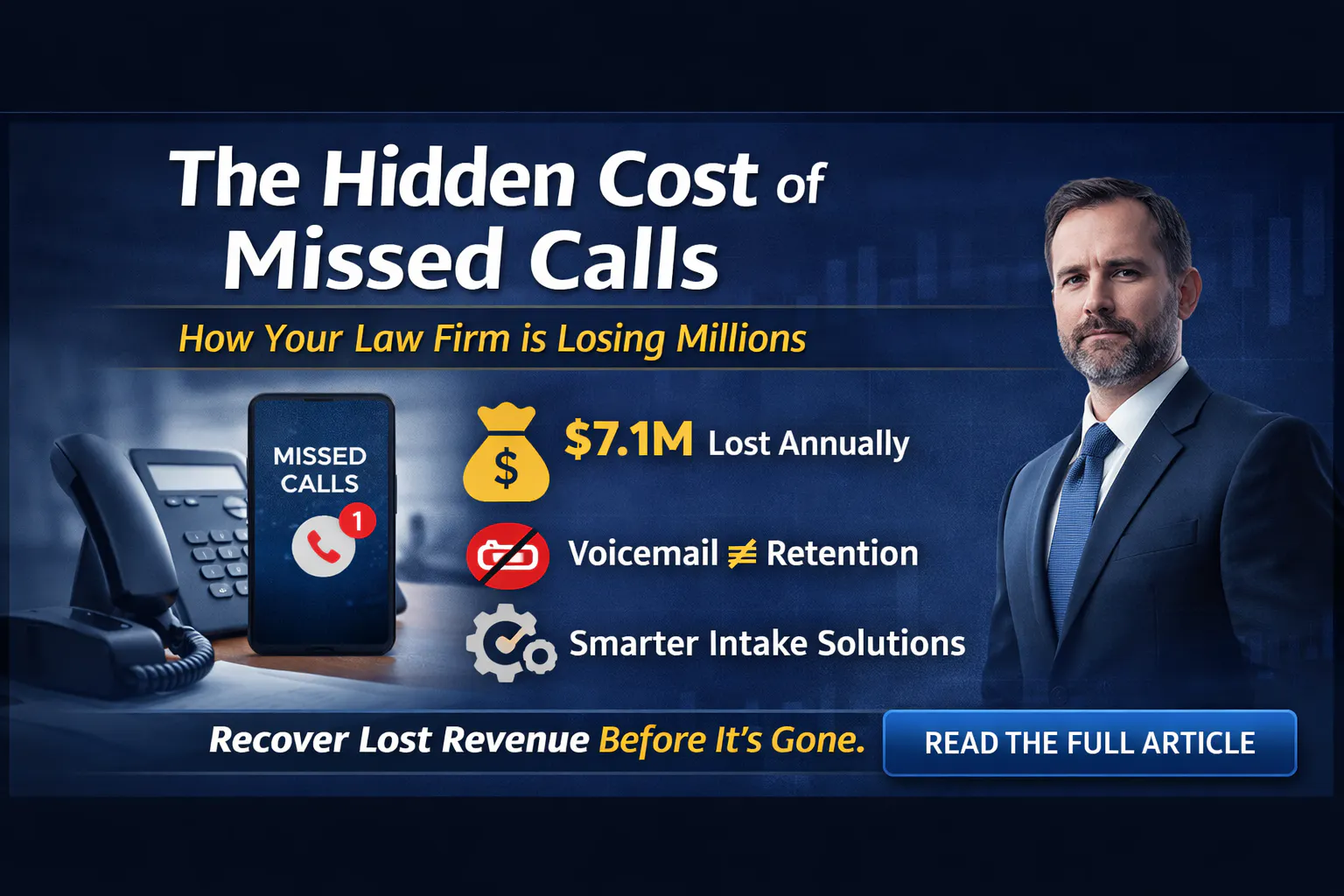
A missed call is not just a missed conversation. For many law firms, it is a missed consultation, a missed retained matter, and a hidden leak in the firm’s growth system.
Most firms do not think about missed calls this way.
They think about them as occasional operational friction. Someone was busy. A lawyer was in court. The receptionist was handling another caller. The team planned to call back later. Voicemail would catch it.
But from the prospective client’s point of view, the experience feels very different.
That call may be happening at a moment of stress, urgency, fear, or decision. The caller may have just been injured, received bad news, hit a family breaking point, or finally decided to hire counsel after putting it off for weeks. If the firm does not respond quickly, the opportunity often does not wait.
It moves on.
That is why missed calls cost more than most firms realize. They create lost momentum, lower trust, weaker conversion, and wasted marketing spend, often long before anyone inside the firm notices.
A lot of law firms still treat missed calls like a front-desk issue.
But missed calls sit much closer to revenue than many firms think.
A firm can invest in SEO, referrals, content, PPC, LSAs, and brand credibility. It can generate strong demand. It can have a good website and strong reviews. But if the intake experience breaks at the moment of first contact, that upstream effort becomes less valuable.
That is why missed calls should be viewed as part of the client acquisition system, not as a side issue. This same idea connects closely to Why Intake Is More Than a Phone Function: It Is a Law Firm Growth System and The Law Firm Marketing Funnel: How to Turn More Leads Into Clients.
The phone ringing is not the win.
The win is preserving momentum from inquiry to next step.
The cost of a missed call is rarely just one unanswered conversation.
It can also mean:
This is especially expensive in consumer-facing practice areas where urgency, trust, and speed shape decisions quickly.
That includes practices such as personal injury, immigration, family law, criminal defense, workers' compensation, bankruptcy, estate planning, and disability. In these categories, callers are often not casually browsing. They are trying to act.
If your firm does not answer, another firm often will.
Some firms miss the call entirely.
Others answer too late.
Others answer, but handle the interaction poorly.
That is why the real issue is not just missed calls. It is broken momentum at the top of the funnel.
A healthy intake process should do several things quickly and consistently:
When even one of those steps breaks down, conversion suffers.
That is why this topic pairs naturally with What Is a Good Intake Call for a Law Firm? Best Practices to Improve Client Conversion. The issue is not simply whether the phone rang. It is whether the first interaction moved the relationship forward.
Voicemail feels harmless internally because it gives the impression that the inquiry has been captured.
But to many prospective clients, voicemail feels like delay, uncertainty, and friction.
Some callers do not want to leave details in a voicemail. Some do not trust that anyone will call back. Some simply move on to the next firm because they are contacting multiple offices at once. Others may leave a message but mentally downgrade the firm immediately.
That is why voicemail should be treated as a backup, not a strategy.
If a firm relies too heavily on voicemail, it is often accepting more intake leakage than it realizes.
A delayed callback often feels safer internally because technically the team did follow up.
But from the caller’s point of view, delay can feel almost the same as being ignored.
When someone reaches out, they are usually evaluating not just legal credentials, but also responsiveness, organization, clarity, and trust. A delayed response weakens all four.
That does not mean every firm needs a lawyer available every minute of the day.
It does mean the firm needs a system that responds while the inquiry is still warm.
This is exactly why after-hours and overflow intake deserve more attention than they usually get. If that is a challenge at your firm, The After-Hours Gap: Why Law Firms Lose Clients After 5 PM (and How to Fix It) is one of the most relevant next reads.
A missed call is often only the first visible symptom.
The deeper problem is usually weak intake design.
A firm can technically answer the phone and still lose the lead because:
This is why the missed-call conversation should not stop at answer rate. It should expand into intake quality, qualification discipline, follow-up systems, and handoff design.
That is also why this topic connects to Why Law Firms Get Ghosted and How to Fix It. Many firms do not lose leads only at first contact. They also lose them when follow-up lacks structure after that first interaction.
The more a firm spends to generate attention, the more expensive poor responsiveness becomes.
Every unanswered or poorly handled call may represent wasted spend from:
In other words, the firm pays to create the opportunity, then fails to capture it.
That is why missed calls should be viewed not just as an intake issue, but as a marketing ROI issue. This also aligns with Legal Marketing in 2026: Why Visibility Alone No Longer Wins Clients. Visibility matters, but conversion systems determine whether visibility turns into business.
Telling staff to "just call back faster" is rarely enough.
Real improvement usually comes from stronger system design.
That can include:
Used well, these tools do not replace legal judgment. They protect the opportunity long enough for legal judgment to matter.
For firms already using legal software and trying to improve responsiveness without replacing their core system, these related articles may help:
Modern intake systems are designed to reduce leakage at the exact moment most firms are vulnerable.
Done well, they help firms:
At Clerx, this is the role of AI intake.
The goal is not automation for its own sake.
The goal is to help firms capture, qualify, and move opportunities forward before they disappear.
This boundary matters.
Law firms should not automate:
The purpose of stronger intake systems is operational support, not replacement of attorney judgment.
The goal is to make sure that promising inquiries are not lost to silence, delay, or inconsistency before the legal work even starts.
If your firm wants to understand whether missed calls are hurting growth, start with a short operational review.
Look at:
Even a simple audit can reveal whether the firm is quietly leaking demand at first contact.
A missed call is easy to rationalize inside a busy law firm.
But from the client’s side, it often feels like a decision point.
If the firm responds well, the relationship moves forward.
If it does not, the prospect often chooses someone else.
That is why missed calls cost law firms more than they realize.
They do not just reduce responsiveness. They reduce trust, conversion, and the return on everything the firm is already doing to create demand.
For firms that want more predictable growth, fixing missed-call leakage is one of the clearest places to start.
Because before a firm can win the work, it has to capture the opportunity.
Because many legal callers reach out when they are ready to act. If the firm does not respond quickly, the prospect often contacts another lawyer instead.
Yes. A missed call can mean a lost consultation, a lost retained matter, wasted marketing spend, and a weaker conversion rate from demand the firm already generated.
Usually not by itself. Voicemail creates delay and friction, and many prospects will not wait long for a callback.
Yes. Faster response generally increases the chance that a prospect stays engaged and moves to the next step.
A missed call is often the first visible symptom. The larger intake issue usually includes weak follow-up, inconsistent qualification, poor handoff, or unclear ownership of the next step.
Yes. If the first interaction feels cold, confusing, rushed, or unstructured, the prospect may still choose another firm.
In most cases, the firm should capture the caller’s name, phone number, email, practice area, urgency, short matter summary, and a clear next step.
Because firms spend money to generate attention. If the prospect is lost at the first response stage, that spend becomes less effective.
Yes. Many legal inquiries happen outside normal office hours, especially in urgent or emotional situations.
Consumer-facing practices are often hit hardest, including personal injury, immigration, family law, criminal defense, bankruptcy, estate planning, workers' compensation, and disability.
Yes. AI can help with immediate first response, structured intake, after-hours coverage, and keeping leads moving toward the right next step.
They should avoid automating legal advice, case strategy, final legal conclusions, and sensitive fit decisions without oversight.
By tracking answer rate, missed calls, callback time, consultation booking rate, lead-to-client conversion, and after-hours response coverage.
Clerx helps firms improve the first-response and intake layer through immediate response, structured workflows, website chat, and more consistent lead handling.
Audit the problem, improve the intake workflow, strengthen response coverage, and make sure every inquiry leads to a clear next action.
If your firm is generating calls but still losing opportunities to voicemail, delay, or inconsistent intake, book a demo with Clerx.
6/12/2026
Text messaging can improve speed and convenience, but only if the firm treats SMS as part of intake instead of a disconnected side channel.
6/11/2026
Website chat can improve law firm conversions, but only when it helps visitors move forward instead of adding another disconnected intake step.
We use cookies to ensure you get the best experience on our website. For more information, please see our Privacy Policy.
