5/29/2026
Response speed is one of the simplest ways to improve law firm conversion, but most firms still do not have clear benchmarks by channel.
By Attorney Michael Brunman, Co-Founder & CEO of Clerx
For many law firms, lead generation gets most of the attention. Firms invest in referrals, directories, SEO, local visibility, and paid campaigns, then measure whether the phone rings and forms come in.
But the more important question often comes one step later: how fast does the firm actually respond?
That is where a lot of growth gets lost.
A slow response does not always look dramatic internally. A missed call gets returned later. A form sits in an inbox for an hour. A chat message waits until the front desk clears a backlog. A text gets answered once someone has time.
From the prospective client’s perspective, though, that delay often feels like uncertainty. They do not know whether the firm is organized, whether anyone saw the message, or whether they should keep waiting. In many cases, they simply move on.
This is why response speed belongs in the same conversation as Why Intake Is More Than a Phone Function: It Is a Law Firm Growth System, The Hidden Cost of Missed Calls: How Law Firms Lose Revenue Before Intake Even Begins, and The Law Firm Marketing Funnel: How to Turn More Leads Into Clients. Visibility creates the opportunity. Response speed often determines whether the opportunity survives.
Lead response is not just a courtesy metric. It is a conversion metric.
Prospective clients usually reach out at the moment they have enough urgency, confusion, or motivation to take action. That is true whether they are calling after an accident, filling out a form for an immigration issue, sending a text about a family matter, or opening a website chat because they do not want to wait for office hours.
If the firm responds clearly and quickly, momentum builds. If the response is slow, that momentum fades.
This is one reason posts like What Is a Good Intake Call for a Law Firm? Best Practices to Improve Client Conversion, Why Law Firms Get Ghosted and How to Fix It, and Legal Marketing in 2026: Why Visibility Alone No Longer Wins Clients matter so much. The lead is not really “generated” until the firm has done something useful with it.
Many firms know they should be responsive, but they do not define what that means by channel.
That creates inconsistency.
A better approach is to create channel-specific response standards that your team can actually follow and measure. These are not universal laws. They are practical targets that most consumer-facing firms should aim for if they want a strong intake process.
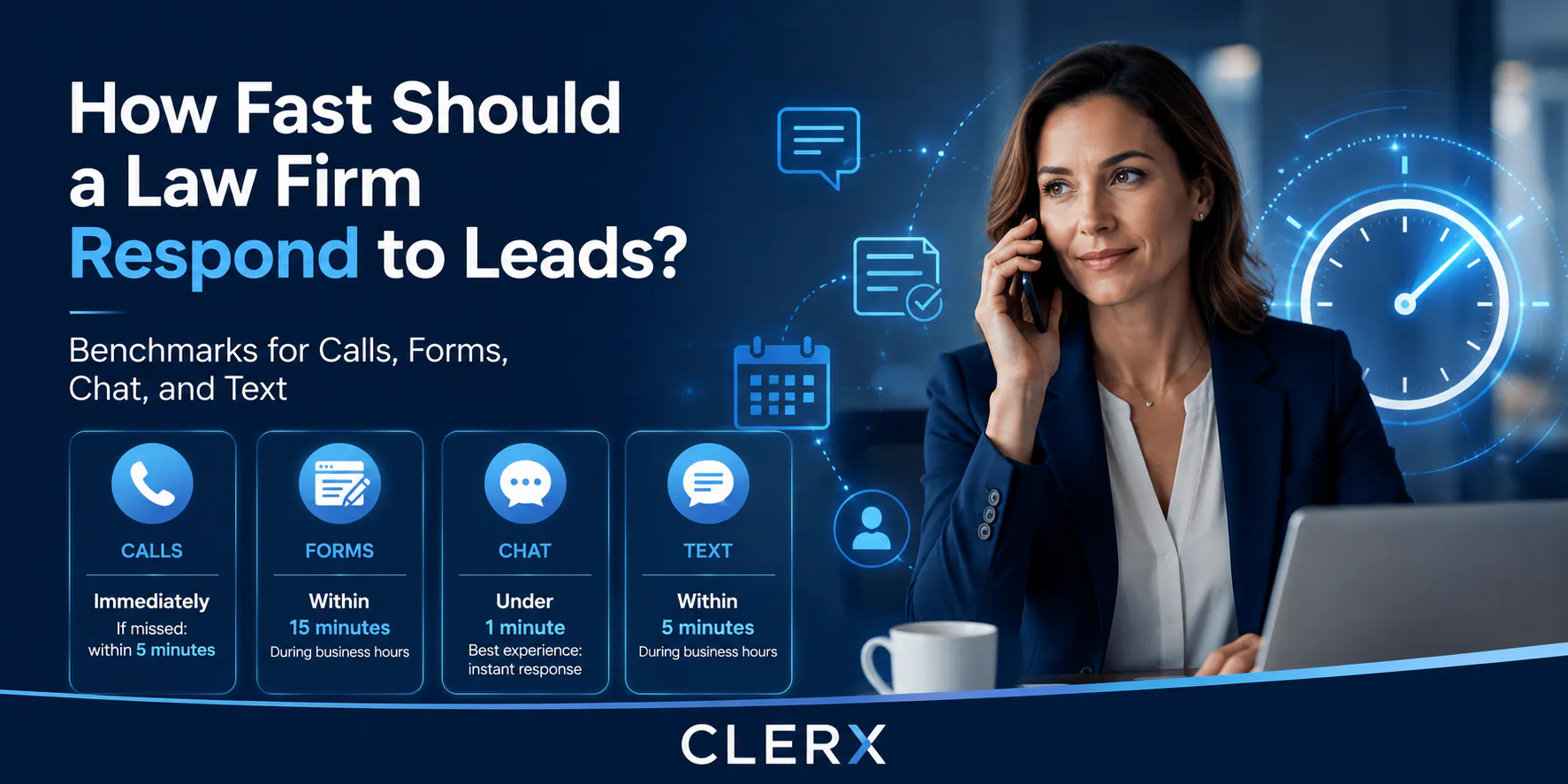
Best target: answer immediately.
If missed: return the call within 5 minutes during business hours.
Calls usually carry the highest urgency. They also tend to come from people who want reassurance quickly. If a caller reaches voicemail and does not hear back soon, the chance of losing them rises sharply.
That is why The After-Hours Gap: Why Law Firms Lose Clients After 5 PM (and How to Fix It), Legal Answering Services in 2026: Which Option Is Right for Your Practice?, and Building a Winning Client Intake Process for Personal Injury Law Firms all point back to the same operational truth: the best call is the one you do not have to “get back to later.”
Best target: immediate acknowledgment plus human review within 15 minutes during business hours.
Absolute outer limit: same business day.
Forms are often treated as lower urgency than calls, but that assumption is risky. A person filling out a form may be just as ready to move forward as someone calling. The only difference is channel preference.
A good workflow sends confirmation immediately, routes the lead quickly, and makes sure someone owns the next step. This is where The Complete Guide to Perfecting Law Firm Intake in 2026 and How AI Intake Helps Law Firms Scale Without Adding Overhead are especially useful. Strong intake systems do not let form leads drift because nobody checked them in time.
Best target: under 1 minute.
Best experience: instant first response, then guided next step.
Website chat creates a different expectation than calls and forms. People use chat because they want speed with low friction. If chat sits unanswered for several minutes, the whole point of the channel breaks down.
This is also where firms often confuse availability with usefulness. A chat tool only helps if it moves the visitor forward. That connects closely to Mastering Owned Media for Law Firms in 2026 and The Intake Layer: How Lawcus Users Turn More Leads Into Matters. Website traffic matters less when the first digital interaction still feels slow or disconnected.
Best target: within 5 minutes during business hours.
After hours: immediate acknowledgment or clearly defined next-step reply.
Text sits somewhere between chat and email in user expectations. It feels informal, but that often makes people expect a faster answer. A text that goes unanswered too long can feel even more ignored than a form submission.
This is where coordination matters. If the firm uses text, it should know who owns the channel, how often it is monitored, and how text conversations connect back into the intake process. That same systems question shows up in Can MyCase Automate Client Communication? What Law Firms Should Automate - and What Still Needs an Intake Layer and The Intake Layer: How Filevine Users Turn More Leads Into Matters.
Response standards should still reflect the kind of matters your firm handles.
A personal injury or criminal defense lead often deserves a tighter response target than a lower-urgency estate planning inquiry. But “less urgent” should not become “we will get to it eventually.” Even in slower-moving practices, clear same-day response is usually the right standard.
That is why firms should build both a channel rule and an urgency rule. Calls may always need immediate attention, but some form leads also deserve escalation. The key is consistency.
Most firms do not fail because they lack effort. They fail because they never turned responsiveness into an operating rule.
Common breakdowns include:
These issues are also behind the friction described in Why Law Firms Get Ghosted and How to Fix It, How AI Intake Helps Law Firms Scale Without Adding Overhead, and Legal Marketing in 2026: Why Visibility Alone No Longer Wins Clients. In most firms, speed problems are design problems.
Clerx helps firms strengthen response speed and intake consistency across calls, website chat, and SMS. Donna helps firms answer faster, guide prospective clients through structured first-response workflows, and reduce the friction that causes good leads to disappear.
That matters because better benchmarks only help if the firm can actually meet them.
If you want to see how this could work inside your firm using your current systems, book a short demo here.
Ideally immediately. If the call is missed, a return within five minutes during business hours is a strong working target.
Best practice is immediate acknowledgment and human review within about fifteen minutes during business hours, with same-day response as the outer limit.
Yes. People use chat because they expect a near-immediate interaction. A response target under one minute is a good benchmark.
Text should usually be answered within five minutes during business hours. If that is not realistic, the firm should at least provide an immediate acknowledgment and clear next step.
No. Urgency differs by matter type, but almost every consumer-facing firm benefits from faster response, cleaner routing, and clear same-day standards.
Attorney Michael Brunman, is the Co-Founder and CEO of Clerx. He is a former commercial and intellectual property litigator, Harvard MBA ’23, former PayPal product manager, and former McKinsey consultant. At Clerx, he helps law firms use AI agents to improve client intake, reduce missed calls, and streamline client communication.
6/12/2026
Text messaging can improve speed and convenience, but only if the firm treats SMS as part of intake instead of a disconnected side channel.
6/11/2026
Website chat can improve law firm conversions, but only when it helps visitors move forward instead of adding another disconnected intake step.
We use cookies to ensure you get the best experience on our website. For more information, please see our Privacy Policy.
