3/23/2026
Every missed call is more than a missed conversation. For many law firms, it is a missed client, a missed case fee, and a hidden leak in the growth engine.
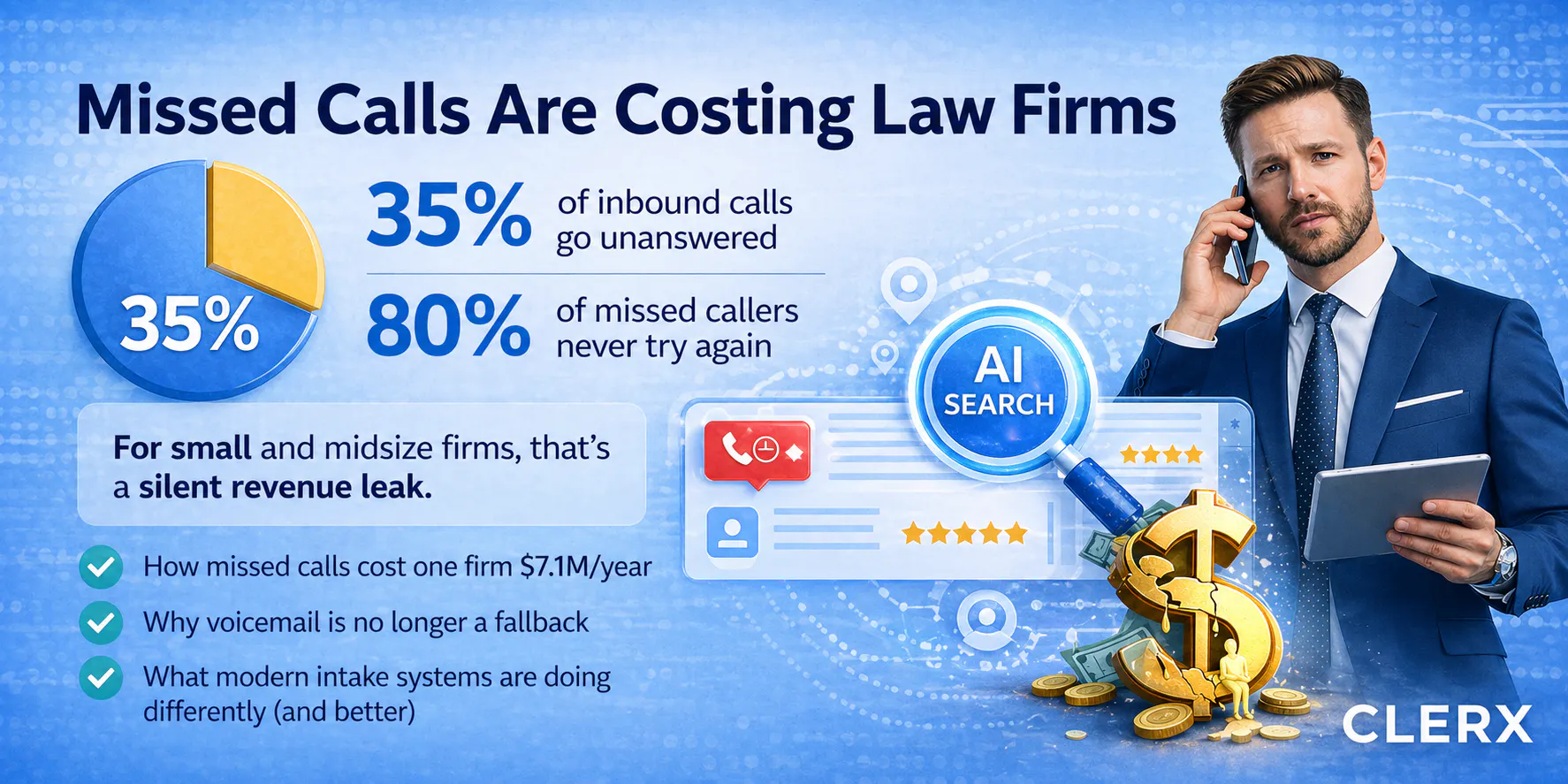
Most law firms do not think of missed calls as a major financial problem. They think of them as a scheduling problem. Someone was in court. The receptionist was busy. The team planned to call back later. Voicemail would catch the message.
But that is not how prospective clients experience the moment.
For the person calling, that missed call may be the most important thing happening in their day. They may have just been injured in an accident, received an immigration update that frightened them, reached a breaking point in a family matter, or finally decided they are ready to hire counsel. When the call goes unanswered, the opportunity often does not pause. It moves on. That is why missed calls are not just an administrative issue. They are a revenue issue, a conversion issue, and a client-experience issue. That core framing comes straight from the source draft and remains the right foundation for this topic.
The legal industry still has a responsiveness problem. The draft cites Clio reporting that 35% of calls from prospective clients go unanswered, 42% of new inquiries wait three or more days for a response, and 79% of consumers consider a lawyer’s prompt response to a first call or email one of the most important factors when choosing counsel. It also cites a 2024 Clio secret-shop study finding that only 40% of firms answered the phone live, and only 52% either answered or called back, leaving 48% effectively unreachable by phone.
That gap matters because legal consumers are usually not calling casually. They are calling because something has happened, and they want to know whether your firm can help. If they reach voicemail, wait too long, or get an inconsistent intake experience, many will try the next firm.
This is the hidden leak in many firms’ growth system. The marketing may be working. The website may be working. The referrals may be working. But the intake layer fails at the moment of contact. That is why this article belongs in the same strategic cluster as Why Intake Is More Than a Phone Function: It Is a Law Firm Growth System, How AI Intake Helps Law Firms Scale Without Adding Overhead, The Complete Guide to Perfecting Law Firm Intake in 2026, and The Complete Guide to Perfecting Law Firm Intake in 2025.
A law firm does not win a client just because the phone rang.
It wins when momentum is preserved from first contact to next step.
That means:
Once that chain breaks, conversion suffers. This is why missed calls matter so much. They are often the earliest visible sign of a deeper intake problem. If you want the broader strategic framing, Why Intake Is More Than a Phone Function: It Is a Law Firm Growth System is the natural companion piece to this article. If you want the operational version, Mastering Law Firm Intake in 2025: Turn First Calls Into Clients, Boost Your Law Firm’s Productivity with Clerx, and Why AI Intake Is the New Standard for High-Performing Law Firms all build on the same idea.
Voicemail used to be treated as a reasonable fallback. Today, it is often a conversion loss.
The draft cites Clio’s 2019 Legal Trends research finding that 39% of calls went to voicemail, 57% of those voicemails were not returned within 72 hours, and 27% of firms were unreachable by phone in that study. Even when a callback eventually happens, it often happens too late. The prospect has cooled off, already called someone else, or mentally categorized the firm as unavailable.
What looks like a small delay internally often feels like a major red flag externally.
That is also why The After-Hours Gap: Why Law Firms Lose Clients After 5 PM (and How to Fix It), Why Law Firms Get Ghosted and How to Fix It, Why More Law Firms Are Upgrading From Virtual Receptionists to AI in 2025, and Legal Answering Services in 2026: Which Option Is Right for Your Practice? are so relevant. They are all really about the same question: what happens when a firm is not ready at the moment the client is.
The cost of missed calls becomes much more severe when lead costs are high, competition is strong, speed matters, case values are meaningful, and callers often reach out under stress or urgency. The source draft correctly points out that personal injury is the clearest example, but not the only one. Immigration, family law, workers’ compensation, bankruptcy, criminal defense, estate planning, and other consumer-facing practices feel this pressure too.
In these areas, many prospects are not browsing. They are trying to act.
This is one reason Clerx’s practice-specific content keeps returning to intake and response speed. See How Family Law Firms Can Use AI to Improve Intake, Responsiveness, and Client Trust, How Estate Planning Firms Can Use AI to Improve Intake, Responsiveness, and Client Experience, and How Real Property Law Firms Can Use AI to Improve Intake, Responsiveness, and Transaction Flow. The practice area changes, but the conversion logic stays the same.
This is where the problem becomes easier to see.
The draft includes an illustrative example: if a firm receives 80 new phone inquiries per month and 35% go unanswered, that means 28 inquiries are missed each month. If just 10% of those missed inquiries would have become clients, that is 2.8 lost matters per month. At an average fee of $15,000, that is about $504,000 in annual lost revenue. The draft then walks through larger scenarios that range from roughly $1.26 million to $4.2 million annually depending on close rate and average matter value. These are explicitly framed as illustrative scenarios, not universal benchmarks, but they show why missed-call leakage can become a very large financial problem.
The point is not that every missed call equals a lost client.
The point is that enough of them do.
This is why How AI Intake Helps Law Firms Scale Without Adding Overhead and Why AI Intake Is the New Standard for High-Performing Law Firms are growth articles, not just legal-tech articles. They are really about protecting revenue that the firm already worked hard to create.
This problem gets even worse when you connect it to acquisition cost.
The draft notes that firms now spend real money to generate demand, and cites Clio’s view that solo and small firms commonly spend between $5,000 and $50,000 a year on marketing, while larger firms may spend far more. That means a missed call is not only a missed opportunity. It may also represent wasted spend on SEO, local SEO, paid search, LSAs, directories, social content, referral development, website design, and conversion work.
In other words, the firm pays to create demand, then loses the value of that demand because nobody answered or responded properly.
That is why missed-call leakage should be treated as both an intake issue and a marketing ROI issue. It is also why this article naturally connects to Can MyCase Automate Client Communication? What Law Firms Should Automate - and What Still Needs an Intake Layer, The Intake Layer: How Lawcus Users Turn More Leads Into Matters, and The Intake Layer: How Filevine Users Turn More Leads Into Matters. Practice-management software matters, but it does not erase front-end leakage by itself.
Some firms do call back. They just call back too late.
That feels safer internally because the team did eventually follow up. But from the prospect’s point of view, delay often feels the same as absence. The draft highlights the five-minute rule in Clio’s intake guidance: the best chance of connecting with a potential client comes when the firm responds within about five minutes of the inquiry.
That does not mean every firm must literally have a lawyer available every minute of the day. It means the firm needs a system that acknowledges and advances the inquiry while interest is still warm.
This is also why the quality of the first call matters as much as the speed. A fast but weak intake call still loses business. That is where Mastering Law Firm Intake in 2025: Turn First Calls Into Clients, Boost Your Law Firm’s Productivity with Clerx, and Why Intake Is More Than a Phone Function: It Is a Law Firm Growth System all reinforce the same lesson: speed and structure have to work together.
A strong intake operation is not just about picking up the phone. The source draft breaks it into five jobs, and that framework holds up well:
When that system is missing, firms often rely on memory, voicemail, handwritten notes, or inconsistent staff habits. That is where revenue leaks.
This is one reason intake design matters so much for firms using existing systems. The intake layer should strengthen the workflow before the matter is opened, not just organize what happens afterward. That is the same theme explored in Can MyCase Automate Client Communication? What Law Firms Should Automate - and What Still Needs an Intake Layer, The Intake Layer: How Lawcus Users Turn More Leads Into Matters, and The Intake Layer: How Filevine Users Turn More Leads Into Matters.
Answering the phone is only part of the problem.
The draft cites Clio reporting that on initial calls, firms fail to collect an email address 86% of the time and fail to collect a phone number 45% of the time. In other words, even when a call is answered, the intake may still be incomplete.
That means the issue is not just availability. It is intake discipline.
A firm can answer a call and still lose the opportunity because:
This is why the right question is not only “Are we answering calls?” It is “Are we turning first contact into a consistent, trackable next step?”
That broader discipline is also what connects Why Law Firms Get Ghosted and How to Fix It, The Complete Guide to Perfecting Law Firm Intake in 2026, and Why AI Intake Is the New Standard for High-Performing Law Firms. Firms rarely lose opportunities because of one big dramatic failure. They lose them through small repeated breakdowns in the first-response system.
One reason firms struggle here is that real inquiries do not arrive neatly between 9 and 5. The draft notes that Clio’s research shows most clients want the option to communicate evenings or weekends, and that technology and automation can improve how clients perceive responsiveness outside normal business hours. At the same time, no firm wants lawyers and staff permanently on call.
That is why the best solution is not simply telling people to work more hours. It is designing systems that extend responsiveness without destroying work-life balance.
If after-hours leakage is part of the problem at your firm, The After-Hours Gap: Why Law Firms Lose Clients After 5 PM (and How to Fix It) is the obvious next read. So are Why More Law Firms Are Upgrading From Virtual Receptionists to AI in 2025 and Legal Answering Services in 2026: Which Option Is Right for Your Practice?.
Leading firms are moving away from voicemail-dependent intake and toward systems that preserve responsiveness even when human staff are unavailable. The source draft highlights a common modern stack:
At Clerx, that is where Donna fits.
Donna helps law firms answer inbound calls, collect structured information, support qualification, and move callers toward the right next step. Website chat can support people who prefer written communication, and automated follow-up can help re-engage leads who would otherwise go cold.
The goal is not automation for its own sake. The goal is to make sure real opportunities are not lost before legal work even begins.
If you want to understand how that intake layer fits with the rest of the firm’s workflow, the best next reads are Can MyCase Automate Client Communication? What Law Firms Should Automate - and What Still Needs an Intake Layer, The Intake Layer: How Lawcus Users Turn More Leads Into Matters, and The Intake Layer: How Filevine Users Turn More Leads Into Matters.
This part matters.
Law firms should absolutely strengthen intake with systems and automation. But they should not outsource legal judgment.
Do not automate:
The right use of AI is operational, not substantive. It supports the communication layer so attorneys can spend more time on legal work and less time chasing missed opportunities. That boundary is consistent across Clerx’s intake writing, including Why Intake Is More Than a Phone Function: It Is a Law Firm Growth System, Why AI Intake Is the New Standard for High-Performing Law Firms, and How AI Intake Helps Law Firms Scale Without Adding Overhead.
You do not need a massive overhaul to improve this. A focused 30-day plan can create real gains.
Track:
Define what every initial interaction should capture:
Decide what happens when staff is unavailable. This may include:
Define the next step for every inquiry:
That 30-day improvement structure is directly reflected in the source draft.
If your firm wants to understand the hidden cost of missed calls, start with a short set of operational metrics:
The draft also notes that Filevine cites a healthy conversion rate after consultation or retainer at 30% or higher, while many firms operate below 10%, and that speed to lead, qualification quality, and follow-up cadence are major contributors. Those are not just intake metrics. They are growth metrics.
This is exactly why missed-call leakage belongs inside the broader growth conversation, not in a narrow operations silo. Firms that want more visibility into how intake affects profitability should also look at How AI Intake Helps Law Firms Scale Without Adding Overhead, Why AI Intake Is the New Standard for High-Performing Law Firms, and the broader Clerx blog.
Clerx helps law firms strengthen the intake and communication layer through faster first response, structured workflows, website chat, SMS, and more consistent lead handling. Donna helps firms answer, qualify, and convert more inquiries without replacing legal judgment.
That matters because most firms do not just need more calls. They need a better system for what happens when those calls come in.
If you want to see how this could work inside your firm using your current systems, book a short demo here.
Many law firms invest heavily in making the phone ring.
Far fewer invest with the same seriousness in what happens when it does.
That is why missed calls are so expensive. They are not just lost conversations. They are lost trust, lost momentum, wasted marketing spend, and lost matters that may never come back.
For firms that want more predictable growth, reducing missed-call leakage is one of the highest-leverage places to start.
Because before a firm can win the work, it has to capture the opportunity.
Because many legal consumers call when they are ready to act. If the call goes unanswered or the response is delayed, they often move on to another firm. That makes missed calls a growth problem, not just a front-desk problem.
Yes. A missed call can represent a lost consultation, a lost retained matter, wasted marketing spend, and reduced conversion from demand your firm already paid to generate.
Usually not. Voicemail creates friction and delay, and many prospects will not wait long or try multiple times.
Yes. Fast response increases the odds of connecting while the prospect is still engaged and actively looking for help. But speed alone is not enough. The interaction also needs empathy, structure, and a clear next step.
As fast as possible. In many consumer-facing practice areas, the first few minutes matter far more than firms realize.
A missed-call problem is often the first visible symptom. The deeper issue is usually weak intake design, inconsistent qualification, poor follow-up, or lack of ownership of the next step.
Yes. If the call feels cold, confusing, rushed, or incomplete, the prospect may still move on even though someone technically answered. This is one reason Mastering Law Firm Intake in 2025: Turn First Calls Into Clients matters so much.
At minimum, most firms should capture the caller’s name, phone number, email, practice area, urgency, short matter summary, and a clear next step.
Because firms often spend heavily on SEO, paid search, LSAs, directories, referrals, and website optimization. If the lead is lost at first contact, that spend becomes less efficient.
Yes. Many prospects reach out outside normal business hours, especially when the issue feels urgent or emotional. That is exactly why The After-Hours Gap: Why Law Firms Lose Clients After 5 PM (and How to Fix It) is such an important companion article.
Consumer-facing firms are often hit hardest, especially personal injury, immigration, family law, workers’ compensation, bankruptcy, criminal defense, estate planning, and similar practices where speed and trust matter.
Yes. AI can help answer calls immediately, support structured intake, capture better data, and keep prospects moving to the next step even when staff is unavailable. For a broader operational view, read How AI Intake Helps Law Firms Scale Without Adding Overhead.
They should not automate legal advice, case strategy, final legal conclusions, or sensitive fit decisions without proper oversight.
Start by measuring answer rate, missed-call rate, callback time, consultation booking rate, after-hours coverage, and lead-to-client conversion by source. Then review whether intake data is being captured consistently and whether follow-up ownership is clear.
Clerx strengthens the intake and communication layer through AI-powered first response, structured workflows, website chat, SMS, and more consistent lead handling.
That can help downstream, but many firms still need a stronger first-response layer. This is the same logic explored in Can MyCase Automate Client Communication? What Law Firms Should Automate - and What Still Needs an Intake Layer, The Intake Layer: How Lawcus Users Turn More Leads Into Matters, and The Intake Layer: How Filevine Users Turn More Leads Into Matters.
A strong next reading path is Why Intake Is More Than a Phone Function: It Is a Law Firm Growth System, The Complete Guide to Perfecting Law Firm Intake in 2026, Why Law Firms Get Ghosted and How to Fix It, and Legal Answering Services in 2026: Which Option Is Right for Your Practice?.
Audit the problem, standardize intake, improve response coverage, and make sure every inquiry leads to a clear next action instead of sitting in voicemail or scattered notes. If you want to see how Clerx can help your firm reduce missed-call leakage across calls, website chat, and SMS, book a demo here.
6/12/2026
Text messaging can improve speed and convenience, but only if the firm treats SMS as part of intake instead of a disconnected side channel.
6/11/2026
Website chat can improve law firm conversions, but only when it helps visitors move forward instead of adding another disconnected intake step.
We use cookies to ensure you get the best experience on our website. For more information, please see our Privacy Policy.
