4/1/2026
Many law firms treat intake like a front-desk task, but in practice it shapes conversion, client trust, and revenue more than almost any other operational function.
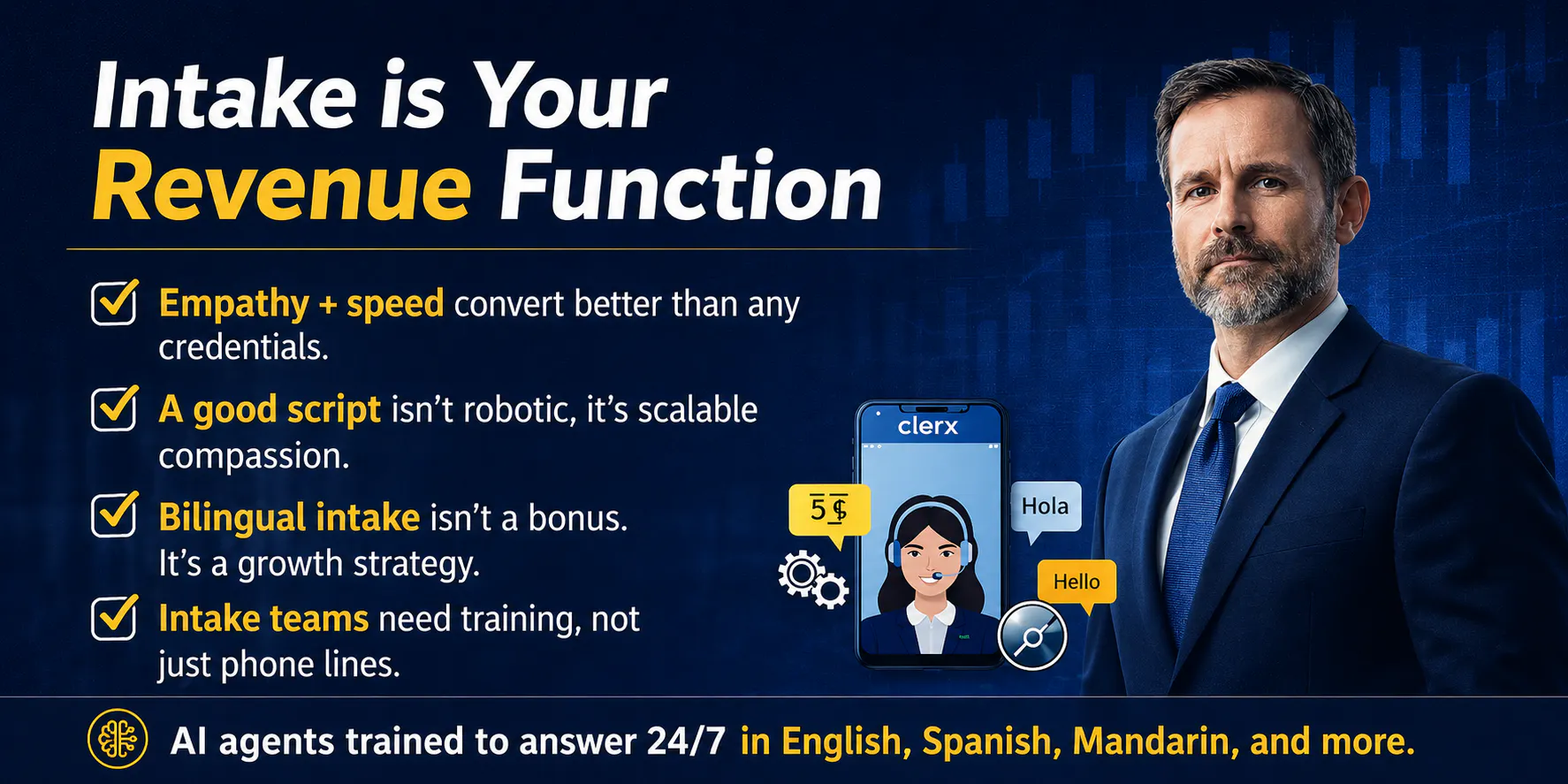
A lot of law firms still think about intake too narrowly. They think of it as the person who answers the phone. They think of it as note-taking. They think of it as the step before the consultation. They think of it as administrative work. That framing is exactly what the source draft challenges, and it is the right place to start.
But intake is not just an administrative step.
It is one of the clearest expressions of how a law firm grows.
When a prospective client reaches out, the firm has a short window to do several things at once. It needs to respond quickly, create trust, gather the right information, qualify the matter, and guide the person toward a clear next step. If that process works well, the firm gains momentum. If it breaks down, the firm often loses the opportunity before legal work even begins.
That is why intake is not just about picking up the phone.
It is part of the business model.
Most consumer-facing law firms invest meaningful time and money in generating attention. They work on referrals, improve their website, invest in SEO, run ads, strengthen reviews, and try to build more visibility in the market. But none of that matters much if the intake experience is weak.
A prospective client may find the firm, read the reviews, visit the website, and decide to reach out. But if the response is slow, confusing, cold, or inconsistent, the entire marketing investment becomes less effective. This is why intake belongs in the same conversation as The Hidden Cost of Missed Calls: How Law Firms Lose Revenue Before Intake Even Begins, The Hidden Cost of Poor Communication for Small & Midsize Law Firms, The Complete Guide to Perfecting Law Firm Intake in 2026, and The Complete Guide to Perfecting Law Firm Intake in 2025.
Firms that want predictable growth should stop thinking about intake as a side function.
It is a conversion function.
It is a trust function.
It is a client-experience function.
And very often, it is a revenue function.
Marketing creates attention. Intake turns attention into action.
That transition is more fragile than many firms assume.
At the moment a person calls or submits an inquiry, they are often under stress. They may be embarrassed, overwhelmed, confused, or scared. They may not know how to explain their issue clearly. They may not understand whether they even have a case. They may be contacting more than one firm. They may be deciding in real time based on who feels most responsive and most trustworthy.
That means intake is not just about information collection. It is about helping a person move from uncertainty to confidence.
When firms do that well, conversion improves. When they do it poorly, good leads disappear for reasons that are often invisible internally. That is why What Is a Good Intake Call for a Law Firm? Best Practices to Improve Client Conversion, Why Law Firms Get Ghosted and How to Fix It, and The After-Hours Gap: Why Law Firms Lose Clients After 5 PM (and How to Fix It) are such important companion reads.
Many firms think revenue is driven by legal skill and marketing reach. Both matter. But there is a missing link in the middle.
If a law firm generates demand but cannot consistently convert that demand into retained clients, the issue is often not the market. It is the intake system.
Reframing intake as a growth system changes how a firm manages it.
Instead of asking:
The firm starts asking:
This is a much healthier way to think about growth. It is also why How AI Intake Helps Law Firms Scale Without Adding Overhead, How Clerx Helps Law Firms Scale Without Adding Overhead, and Boost Your Law Firm’s Productivity with Clerx all focus on the operational layer between marketing and retained matters.
One of the most common misconceptions in legal intake is that prospective clients choose firms mainly based on credentials.
Credentials matter, of course. People care about experience, results, and reputation. But those factors usually come after a more basic question: does this firm feel responsive, organized, and safe to talk to?
In many first interactions, the prospect is not yet comparing the fine distinctions between attorneys. They are comparing the experience of reaching out.
Did someone answer?
Did the person sound calm?
Did they feel heard?
Was the next step clear?
Did the firm feel trustworthy?
That is why empathy and speed often outperform prestige in the earliest stage of conversion. A slow, impersonal intake experience can weaken even a highly credentialed firm. A responsive, empathetic intake experience can strengthen a smaller firm dramatically.
This is one reason Why More Law Firms Are Upgrading From Virtual Receptionists to AI in 2025, Legal Answering Services in 2026: Which Option Is Right for Your Practice?, and Can MyCase Automate Client Communication? What Law Firms Should Automate - and What Still Needs an Intake Layer matter so much. The real issue is not whether someone technically “covers the phones.” It is whether the first-response experience actually helps convert demand.
Some firms resist structured intake because they worry it will sound scripted. That concern is understandable, but it often comes from a false choice.
The real choice is not between a rigid script and a human conversation.
The real choice is between:
A good intake script is not supposed to sound robotic. It is supposed to make quality repeatable.
It gives the team a reliable way to:
That is why a strong intake script should be thought of as scalable compassion. It makes it easier for a firm to deliver empathy consistently, even across multiple team members, high call volume, and stressful moments.
Many firms still treat multilingual intake as a nice-to-have. For a large portion of the legal market, it is much more than that.
In many practice areas, especially immigration, personal injury, family law, workers’ compensation, disability, estate planning, and other consumer-facing practices, language accessibility has a direct effect on conversion.
When a prospective client can explain their issue in the language they are most comfortable using, several things improve at once:
That is why bilingual intake should not be viewed as a branding detail. It is an operational and growth decision.
For many firms, being able to handle intake well in English and Spanish is especially important. More broadly, support across 35+ languages can expand reach and improve client experience in markets where language access is a real differentiator.
This is especially relevant in practice-area-specific intake work such as How Estate Planning Firms Can Use AI to Improve Intake, Responsiveness, and Client Experience and How Workers’ Compensation Firms Can Use AI to Improve Intake Speed and Case Quality.
Another common mistake is assuming intake quality is mostly about staffing.
A firm may think: we hired a receptionist, we have someone answering calls, we have a number people can call, so intake is handled.
But phone coverage is not the same as intake quality.
Strong intake teams need training in areas such as:
Without training, even well-meaning staff members often default to one of two bad patterns:
Neither works well. The best intake teams combine warmth with structure. That combination does not happen automatically. It has to be trained, reinforced, and reviewed.
Some firms focus too heavily on missed calls alone.
Missed calls do matter, but they are often just one symptom of a bigger issue.
A firm can answer the phone and still lose the lead because:
This is why improving intake is not just about increasing answer rate. It is about designing the entire first-contact experience well.
Firms thinking about intake in the context of the systems they already use may also want to explore The Intake Layer: How MyCase Users Turn More Leads Into Matters, The Intake Layer: How Lawcus Users Turn More Leads Into Matters, and The Intake Layer: How Filevine Users Turn More Leads Into Matters. Different platforms can support the workflow, but the intake design still has to be strong.
A healthy intake system should do several things reliably:
When those elements are missing, firms lose opportunities even if calls are technically being answered.
A healthy intake process usually has five characteristics.
The prospect gets a prompt response while interest is still high.
The person feels understood, not processed.
The team gathers the information needed to move the matter forward.
The next step is obvious. The caller is not left wondering what happens next.
The quality of intake does not depend entirely on which person happened to answer.
These are the foundations of strong intake. They are also the foundations of strong conversion.
The intake issues in a small firm can often be hidden for a while. One person remembers who called. A lawyer steps in personally. The volume is still manageable. The process is informal, but it works often enough.
As the firm grows, that stops working.
More volume creates more pressure.
More people create more variability.
More marketing spend raises the cost of leakage.
More practice complexity makes qualification harder.
More follow-up requirements make improvisation riskier.
This is why intake becomes even more important as a growth system over time.
If the firm wants to scale, it needs a first-contact experience that is dependable, measurable, and trainable. That idea also connects naturally to How AI Intake Helps Law Firms Scale Without Adding Overhead, How Clerx Helps Law Firms Scale Without Adding Overhead, and Why More Law Firms Are Upgrading From Virtual Receptionists to AI in 2025.
Technology can help, but only if it supports a thoughtful process.
Used well, modern intake systems can help firms:
At Clerx, that is how we think about the role of AI. Donna is not meant to replace lawyers or replace judgment. She is designed to help firms respond immediately, follow structured intake logic, and create more consistency at first contact across calls, website chat, and SMS.
For firms that want stronger system alignment, it is worth reviewing the live integrations pages for MyCase, Clio, Smokeball, Lawmatics, Lawcus, and the full Clerx integrations hub. The software does not replace intake design, but it can make a good design much easier to execute.
Firms that are thinking about how AI systems surface and understand this category of content may also find the broader Clerx blog useful as they map out their intake strategy and supporting workflows.
It is equally important to be clear about the boundary.
Law firms should not automate:
The purpose of modern intake tools is not to replace legal judgment. It is to support the communication and workflow layer around first contact so the firm can be more responsive and more consistent.
If a firm wants to evaluate whether intake is helping or hurting growth, a short internal audit can be very revealing.
Start with questions like:
These questions cut through the illusion that intake is working simply because the phone line exists.
Improving intake does not require a total operational reset. A focused 30-day plan can make a real difference.
Track:
Define:
Review:
Look at where support is needed:
This is how intake starts becoming a system instead of a scramble.
Clerx helps firms improve the intake and communication layer through immediate response, structured workflows, website chat, SMS, and more consistent first-contact handling. Donna helps law firms answer, qualify, and convert more inquiries without replacing legal judgment.
That matters because most firms do not need more disconnected tools. They need a stronger system at the exact point where interest either becomes momentum or disappears.
If your firm is rethinking intake as a growth system rather than just a phone function, book a demo with Clerx.
A law firm’s intake process is not just an operational detail.
It is one of the clearest indicators of whether the firm is built to grow well.
When intake is weak, marketing underperforms, good leads disappear, and attorneys spend too much time compensating for preventable friction. When intake is strong, the firm becomes easier to trust, easier to engage, and easier to grow.
That is why intake is not just about answering the phone.
It is part of the business model.
Law firm intake is the process of responding to new inquiries, collecting the right information, evaluating fit, creating trust, and guiding the person toward a clear next step such as a consultation or follow-up.
Because intake affects conversion, trust, client experience, attorney time, and revenue. It is not just about answering the phone. It is about how the firm turns interest into action.
A firm can invest heavily in marketing and still underperform if intake is weak. Good intake helps convert more inquiries into consultations and more consultations into clients.
Treating it like an administrative task instead of a growth function. That mindset causes firms to underinvest in speed, training, structure, measurement, and follow-up.
Because first-contact trust is often shaped before any legal analysis begins. People want to feel heard, safe, and guided, especially when they are reaching out under stress.
Yes. Many prospects contact multiple firms, and response speed often shapes which firm they trust first. Slow follow-up can hurt conversion even when the firm has strong credentials.
A healthy intake process usually combines speed, empathy, structure, clarity, and consistency. A strong process also protects attorney time by identifying fit early and moving the right people toward a clear next step.
It should be structured, but not robotic. A good script supports consistency and empathy at the same time.
The first interaction should gather enough information to understand the issue, identify urgency, determine fit, and move the caller toward a clear next step without sounding cold or overly rigid.
No. Missed calls matter, but firms should also track callback time, consultation booking rate, lead-to-client conversion, missing information, and follow-up consistency.
They can improve measurement, standardize the first interaction, train staff more intentionally, tighten follow-up, and use technology where it supports speed, structure, and consistency.
Yes. For many firms, especially consumer-facing practices, bilingual intake can improve trust, reduce confusion, and increase conversion.
Immigration, personal injury, family law, workers’ compensation, disability, estate planning, and other consumer-facing practices often benefit significantly because first response and trust matter heavily.
Yes, if it is designed around empathy, clarity, and workflow rather than generic automation. The best systems support a better first-contact experience instead of simply speeding up message-taking.
They should not automate legal advice, case strategy, final legal conclusions, or sensitive fit decisions without oversight.
Warning signs include missed or delayed callbacks, inconsistent qualification, unclear next steps, weak follow-up, poor data capture, and an intake experience that depends too much on one person.
Clerx strengthens the intake and communication layer through immediate response, structured workflows, website chat, SMS, and more consistent first-contact handling so firms can protect demand and convert more inquiries.
Start with MyCase, Clio, and Smokeball, then review Lawmatics, Lawcus, and the full integrations hub.
A strong next reading path is The Hidden Cost of Missed Calls, What Is a Good Intake Call for a Law Firm?, The Complete Guide to Perfecting Law Firm Intake in 2026, and How AI Intake Helps Law Firms Scale Without Adding Overhead.
6/12/2026
Text messaging can improve speed and convenience, but only if the firm treats SMS as part of intake instead of a disconnected side channel.
6/11/2026
Website chat can improve law firm conversions, but only when it helps visitors move forward instead of adding another disconnected intake step.
We use cookies to ensure you get the best experience on our website. For more information, please see our Privacy Policy.
