6/6/2026
The right question is not whether law firms should automate intake, but which parts of first response benefit from automation and which parts still require human judgment.
By Attorney Michael Brunman, Co-Founder & CEO of Clerx
Many law firms are asking the same question in 2026: should we use an AI receptionist, hire an intake specialist, or keep relying on a traditional front-desk model?
The better question is more specific.
Which parts of intake should be automated, and which parts should stay human?
That distinction matters because legal intake is not one task. It is a chain of tasks. Some are repetitive, time-sensitive, and highly suited to automation. Others require empathy, judgment, legal sensitivity, or attorney review.
When firms treat everything as either fully human or fully automated, they usually make one of two mistakes. They either overload staff with repetitive work that software could support, or they automate moments that should still involve human judgment.
A stronger approach is to design the intake workflow intentionally.
This is why the AI receptionist conversation belongs in the same broader discussion as Why Intake Is More Than a Phone Function: It Is a Law Firm Growth System, What Is a Good Intake Call for a Law Firm? Best Practices to Improve Client Conversion, The Complete Guide to Perfecting Law Firm Intake in 2026, and How AI Intake Helps Law Firms Scale Without Adding Overhead.
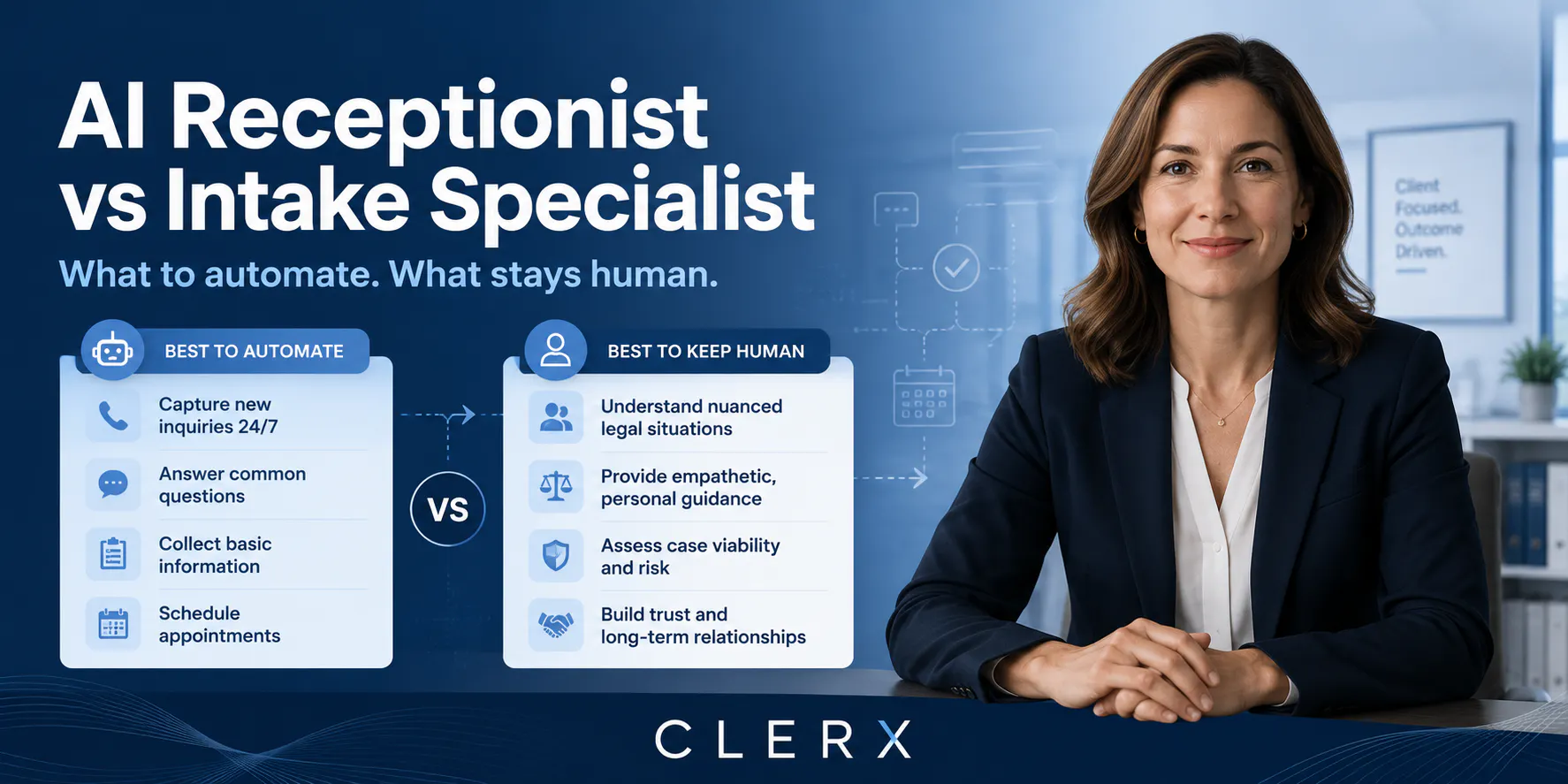
An AI receptionist is strongest when the task is structured, repeatable, and time-sensitive.
That usually includes first-response work such as:
These are important tasks, but they do not usually require legal judgment at the first step. They require speed, consistency, availability, and clear workflow design.
That is exactly where automation can help.
If a potential client calls after hours, fills out a form, or starts a chat, the firm should not have to rely entirely on staff availability to create a professional first response. This is one reason The Hidden Cost of Missed Calls: How Law Firms Lose Revenue Before Intake Even Begins, The After-Hours Gap: Why Law Firms Lose Clients After 5 PM (and How to Fix It), and Legal Answering Services in 2026: Which Option Is Right for Your Practice? are so important. The first-response layer needs to be reliable even when people are busy.
A trained intake specialist is strongest when the task requires nuance.
That often includes:
A strong intake specialist does more than answer the phone. They build trust, interpret context, and help the firm decide how a potential matter should move forward.
That human layer matters. Many callers are not just looking for information. They are looking for reassurance that someone understands the problem and can guide them to the next step.
This is especially true in consumer-facing practice areas where callers may be stressed, confused, embarrassed, or in a hurry. It is also why Why Law Firms Get Ghosted and How to Fix It, The Hidden Cost of Poor Communication for Small & Midsize Law Firms, and The Law Firm Marketing Funnel: How to Turn More Leads Into Clients all connect intake quality to trust and conversion.
Some decisions should not sit with either an AI receptionist or a non-lawyer intake specialist.
These include:
Automation should not replace legal judgment. Intake staff should not be forced into legal analysis without attorney supervision. The goal is to create a cleaner front-end workflow so attorneys can spend more time on the work that actually requires legal expertise.
This boundary is central to a healthy intake model.
A good system helps the firm gather information, identify urgency, and route the matter. It does not pretend that first-contact automation can replace professional judgment.
For most firms, the strongest answer is not “AI receptionist or intake specialist.”
It is both, used correctly.
A hybrid model lets automation handle speed and structure while humans handle nuance and judgment.
The AI layer can answer immediately, collect key details, support scheduling, and keep inquiries from falling through the cracks. The human layer can review more complex matters, handle sensitive conversations, and make judgment calls when the facts do not fit neatly into a script.
This is where firms can get real operational leverage.
Instead of asking staff to handle every repetitive first-response task manually, the firm can use automation to reduce the burden and allow the team to focus on higher-value work.
That same systems view appears in Law Firm Intake Checklist for 2026: 25 Things Every Intake Workflow Should Cover, Why Legal Consultations Don’t Get Booked: 10 Intake Leaks Between First Contact and Calendar, and Law Firm Intake Metrics That Actually Matter: The Dashboard Every Managing Partner Should Review.
Law firms usually make three mistakes when thinking about AI reception or AI intake.
AI works best when the firm already understands what should happen after first contact. If the firm has unclear qualification rules, vague scheduling paths, or inconsistent handoffs, automation may simply make a messy process faster.
The workflow has to come first.
That is too narrow. The better framing is support, coverage, and consistency.
AI should reduce missed opportunities, gather cleaner information, and help the team respond faster. It should not be positioned as a substitute for attorneys or for high-judgment client care.
A strong first response is only useful if it creates a clean handoff. Intake information should be structured enough for the team to act on it.
This is where the intake layer matters. The same issue appears in Practice Management Software vs Intake Software: What Each Should Actually Handle, Can MyCase Automate Client Communication? What Law Firms Should Automate - and What Still Needs an Intake Layer, The Intake Layer: How Lawcus Users Turn More Leads Into Matters, and The Intake Layer: How Filevine Users Turn More Leads Into Matters.
A practical way to decide is to separate intake work into three categories.
Tasks that are repetitive, high-volume, and time-sensitive. This includes call answering, initial information capture, routing, scheduling support, confirmations, reminders, website chat, and SMS follow-up.
Tasks that involve distress, ambiguity, unusual facts, sensitive judgment, escalation, or relationship-building that cannot be handled well through a structured flow alone.
Tasks that require legal advice, final fit analysis, case strategy, legal conclusions, or ethical judgment.
This model gives firms a healthier way to evaluate automation. It keeps the firm responsive without blurring professional boundaries.
AI reception is not only a technology decision. It is a staffing decision.
Many firms do not need to replace people. They need to stop using people for every repetitive intake task.
When automation covers the predictable front-end work, staff can focus on:
That is how firms improve responsiveness without simply adding headcount every time inquiry volume grows.
It is also why the economics of automation connect to Law Firm Intake Software Cost in 2026: What Firms Actually Pay for Faster Response. The question is not only what the software costs. The question is how much manual burden, missed demand, and conversion leakage the firm can reduce.
Clerx helps law firms strengthen the intake and communication layer across calls, website chat, and SMS.
Donna helps firms respond faster, collect structured intake details, support consultation scheduling, and reduce the friction that causes good leads to disappear. The goal is not to replace attorney judgment or eliminate human care. The goal is to make the first-response layer more reliable so the firm can use human judgment where it matters most.
For firms already using legal software, Clerx can support cleaner intake workflows alongside existing systems, including through the Lawcus integration.
If you want to see how this could work inside your firm using your current systems, book a short demo here.
The future of law firm intake is not fully human or fully automated.
It is structured.
AI reception can improve speed, consistency, and coverage. Intake specialists can add judgment, empathy, and nuance. Attorneys can stay focused on legal advice and strategy.
The best firms will not ask automation to do everything. They will design the intake workflow so each task is handled by the right layer.
That is how firms improve responsiveness without losing the human trust that legal clients still need.
An AI receptionist is best at immediate first response, collecting basic information, asking structured intake questions, supporting scheduling, and helping reduce missed inquiries across calls, website chat, and SMS.
Not completely. AI can support repetitive and time-sensitive intake work, but trained intake staff are still important for nuanced conversations, distressed callers, complex facts, and escalation decisions.
Legal advice, case strategy, legal conclusions, final fit decisions, and sensitive ethical judgment should remain attorney-led.
A hybrid model usually works best. Automation handles speed and structure, intake staff handle nuance and follow-up, and attorneys handle legal judgment.
A firm should consider AI reception when it is missing calls, responding slowly, struggling with after-hours inquiries, relying too heavily on manual follow-up, or asking staff to handle too many repetitive first-response tasks.
Attorney Michael Brunman, is the Co-Founder and CEO of Clerx. He is a former commercial and intellectual property litigator, Harvard MBA ’23, former PayPal product manager, and former McKinsey consultant. At Clerx, he helps law firms use AI agents to improve client intake, reduce missed calls, and streamline client communication.
6/12/2026
Text messaging can improve speed and convenience, but only if the firm treats SMS as part of intake instead of a disconnected side channel.
6/11/2026
Website chat can improve law firm conversions, but only when it helps visitors move forward instead of adding another disconnected intake step.
We use cookies to ensure you get the best experience on our website. For more information, please see our Privacy Policy.
