6/12/2026
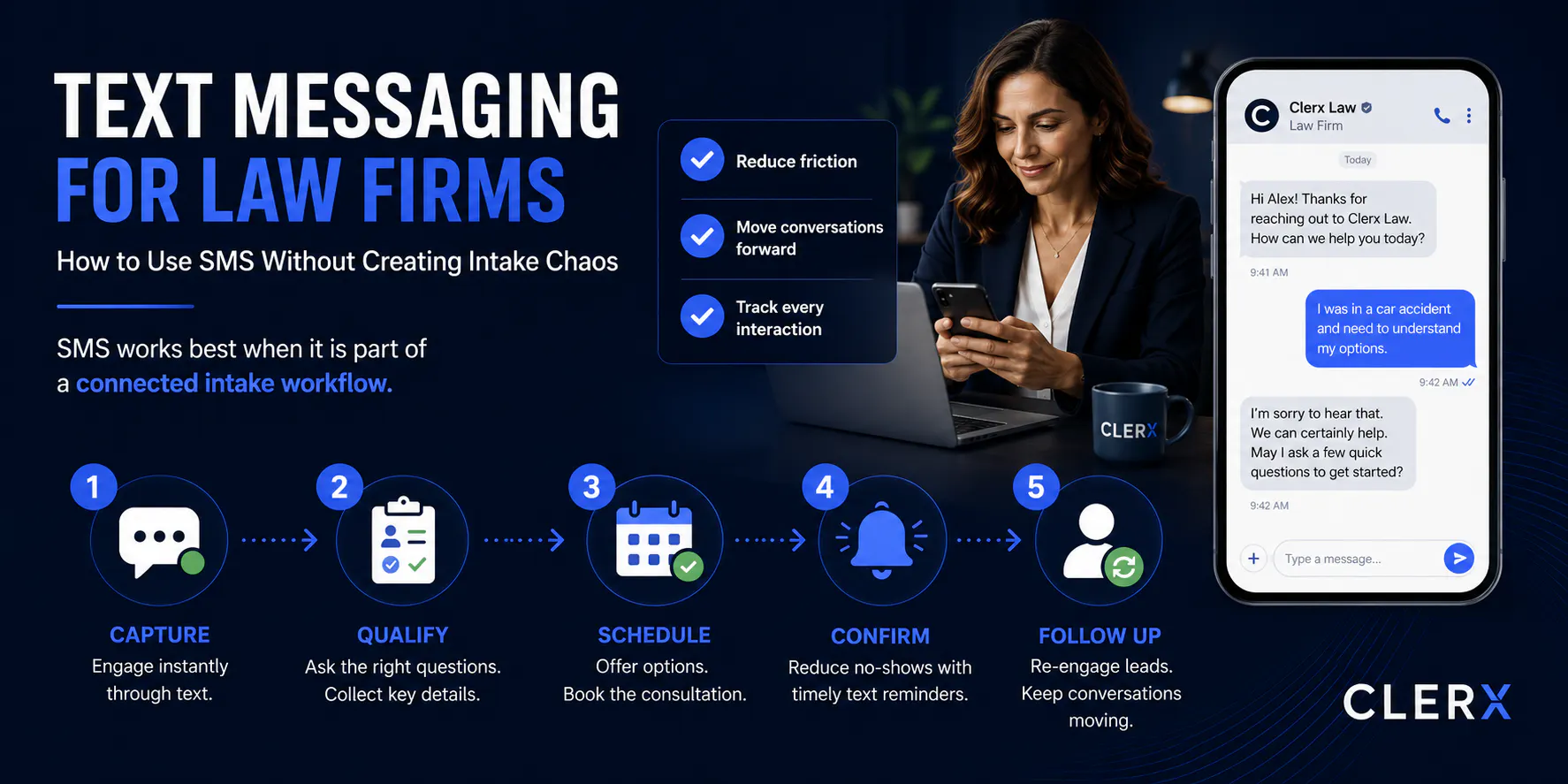
Text messaging can improve speed and convenience, but only if the firm treats SMS as part of intake instead of a disconnected side channel.
By Attorney Michael Brunman, Co-Founder & CEO of Clerx
Text messaging can be one of the most effective communication channels for a law firm.
It is fast. It is convenient. It feels natural to many prospective clients. It can help firms confirm consultations, follow up after missed calls, re-engage leads, send reminders, and reduce friction between first contact and the next step.
But text messaging can also create chaos.
If SMS is not connected to the firm’s intake workflow, it can become another inbox to monitor, another place where information gets lost, and another channel where no one clearly owns the next step.
That is why law firms should not think about text messaging as a standalone tool. They should think about it as part of intake.
This is the same broader idea behind Why Intake Is More Than a Phone Function: It Is a Law Firm Growth System, What Is a Good Intake Call for a Law Firm? Best Practices to Improve Client Conversion, The Complete Guide to Perfecting Law Firm Intake in 2026, and The Law Firm Marketing Funnel: How to Turn More Leads Into Clients. The channel matters, but the system around the channel matters more.
Prospective clients do not always want to call.
Some are at work. Some are in public. Some are anxious. Some prefer to type before speaking. Some simply expect businesses to communicate by text because that is how they manage much of their daily life.
For law firms, this creates a real opportunity. Text messaging can help the firm:
This is especially useful for consumer-facing firms where people often reach out under stress and need a quick, clear response.
But the opportunity only works when text is connected to the rest of the intake process.
Text messaging becomes a problem when it sits outside the firm’s main workflow.
Common issues include:
When this happens, SMS may feel convenient to the client, but messy for the firm.
That is why text messaging should be evaluated alongside The Hidden Cost of Missed Calls: How Law Firms Lose Revenue Before Intake Even Begins, The After-Hours Gap: Why Law Firms Lose Clients After 5 PM (and How to Fix It), and Why Law Firms Get Ghosted and How to Fix It. The problem is rarely the channel alone. It is the lack of a reliable next-step process.
Text messaging is best for short, practical, time-sensitive communication.
Strong use cases include:
Text is less ideal for complex explanations, sensitive legal facts, long narratives, or anything that requires legal analysis.
A good rule is simple: use text to move the person to the next step, not to handle the whole matter.
Text messaging can support intake, but it should not become an endless back-and-forth conversation.
A strong SMS intake workflow should collect only what is needed to route or move the inquiry forward, such as:
That information should then connect to the firm’s broader intake process. It should not live only inside a phone thread.
This is where SMS overlaps with form design, qualification, and consultation booking. A firm that uses text well should still follow the same intake principles covered in How AI Intake Helps Law Firms Scale Without Adding Overhead, Legal Answering Services in 2026: Which Option Is Right for Your Practice?, and The Hidden Cost of Poor Communication for Small & Midsize Law Firms.
Before a firm expands SMS, it should answer a few operational questions:
Without ownership rules, text messaging becomes another source of ambiguity.
This is especially important for firms already using legal software. The same intake-layer issue appears in Can MyCase Automate Client Communication? What Law Firms Should Automate - and What Still Needs an Intake Layer, The Intake Layer: How Lawcus Users Turn More Leads Into Matters, and The Intake Layer: How Filevine Users Turn More Leads Into Matters. Practice systems work better when the intake layer feeding them is clean.
The best SMS workflows are short, clear, and action-oriented.
For example, text can help a firm say:
These messages do not try to resolve the legal issue. They reduce friction and guide the prospect forward.
That boundary matters. Text messaging should not provide legal advice, evaluate legal strategy, or make final representation decisions. It should support intake, scheduling, reminders, and follow-up.
A law firm should not add text messaging and assume it is working.
It should measure whether SMS improves:
If text messaging creates more conversations but no more consultations, the workflow may need to be tightened. If texts are improving booking and reducing no-shows, the firm should make SMS a formal part of intake rather than an informal side channel.
This is why text messaging connects naturally to Legal Marketing in 2026: Why Visibility Alone No Longer Wins Clients and Mastering Owned Media for Law Firms in 2026. Visibility creates attention, but communication systems determine whether that attention becomes a real opportunity.
Clerx helps law firms strengthen intake and communication across calls, website chat, and SMS.
Donna can help firms respond faster, collect structured intake details, guide prospects toward consultation, and reduce the manual gaps that cause text conversations to become disconnected or forgotten.
For firms already using legal software, Clerx can support a cleaner intake layer alongside existing workflows, including through the Lawcus integration.
If you want to see how this could work inside your firm using your current systems, book a short demo here.
Text messaging can make a law firm feel faster, more accessible, and easier to work with.
But only if SMS is treated as part of the intake system.
When text messaging is connected to qualification, scheduling, follow-up, and handoff, it can reduce friction and help more prospects move forward. When it is disconnected, it becomes another place where good leads get lost.
The goal is not more messages. The goal is clearer movement from inquiry to next step.
Law firms should use SMS for short, practical communication such as confirming inquiries, following up after missed calls, sending booking links, reminding prospects about consultations, and re-engaging leads that went quiet.
If a text thread becomes sensitive, confusing, or legally complex, the firm should move the conversation to a call, consultation, or attorney-reviewed workflow.
Ownership should be clearly assigned. Whether it sits with intake staff, an AI intake system, or a defined team member, someone must be responsible for response timing, next steps, and documentation.
They should be short, clear, and actionable. A good reminder confirms the appointment time, explains what to expect, and gives the prospect an easy way to confirm, reschedule, or ask for help.
The biggest mistakes are treating text as a disconnected side channel, failing to define ownership, letting important information stay inside threads, using text for legal advice, and not connecting SMS to scheduling and follow-up.
Attorney Michael Brunman, is the Co-Founder and CEO of Clerx. He is a former commercial and intellectual property litigator, Harvard MBA ’23, former PayPal product manager, and former McKinsey consultant. At Clerx, he helps law firms use AI agents to improve client intake, reduce missed calls, and streamline client communication.
6/11/2026
Website chat can improve law firm conversions, but only when it helps visitors move forward instead of adding another disconnected intake step.
6/10/2026
No-shows are rarely random, and firms that manage reminders, confirmations, and follow-up well usually see better consultation outcomes.
We use cookies to ensure you get the best experience on our website. For more information, please see our Privacy Policy.
