6/11/2026
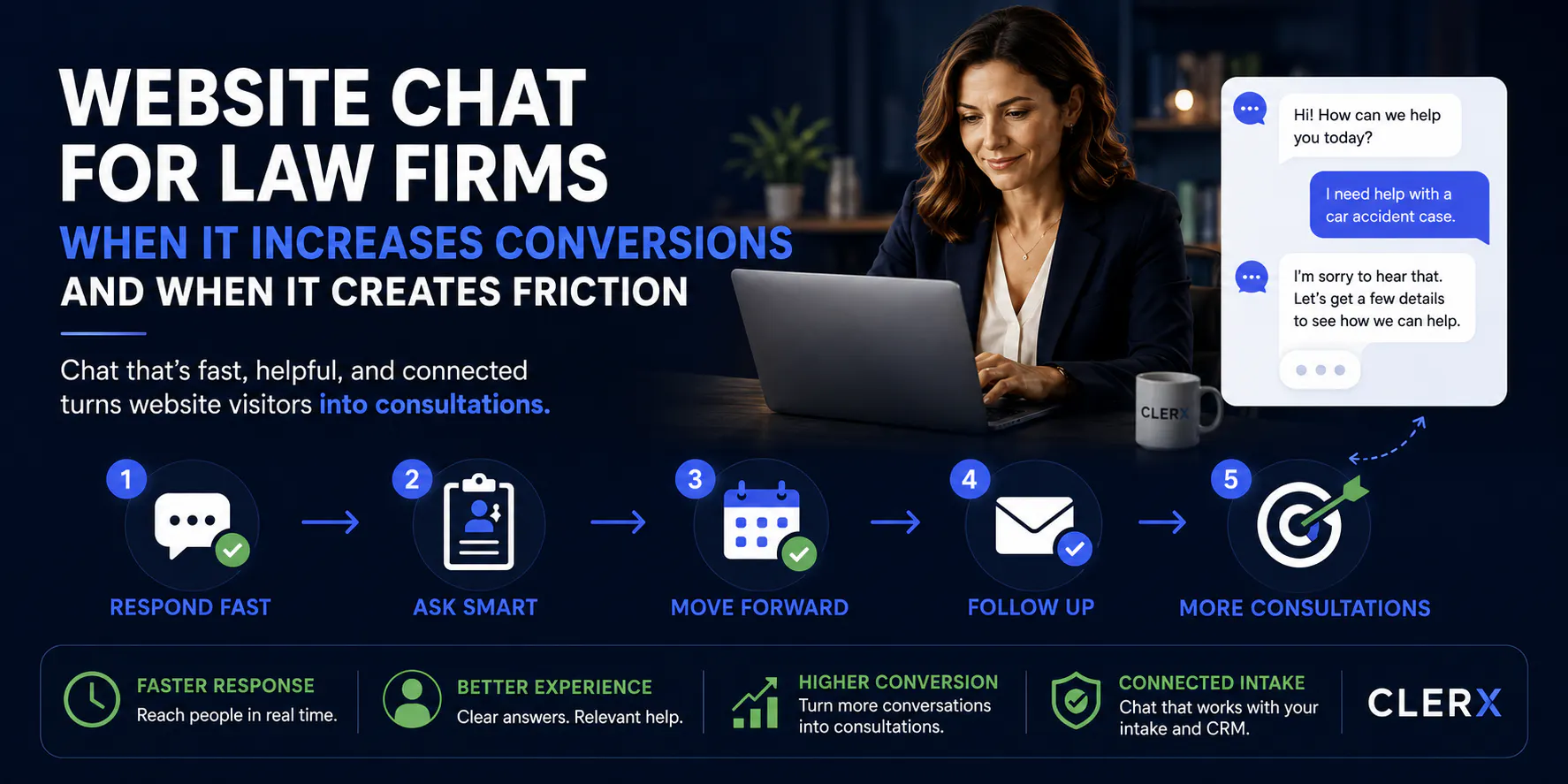
Website chat can improve law firm conversions, but only when it helps visitors move forward instead of adding another disconnected intake step.
By Attorney Michael Brunman, Co-Founder & CEO of Clerx
Website chat can be one of the most useful intake channels on a law firm website.
It can help visitors ask questions without picking up the phone. It can capture leads after hours. It can guide people toward consultations. It can reduce friction for prospects who are not ready to call but are ready to engage.
But website chat can also create problems.
If it is slow, disconnected, generic, or poorly routed, it can make the firm feel less responsive, not more. A chat window that opens but does not move the visitor forward can create the same frustration as voicemail, just in a different format.
That is why website chat should not be treated as a standalone website feature. It should be part of the firm’s intake system.
This is also why website chat belongs in the same broader conversation as Why Intake Is More Than a Phone Function: It Is a Law Firm Growth System, What Is a Good Intake Call for a Law Firm? Best Practices to Improve Client Conversion, The Complete Guide to Perfecting Law Firm Intake in 2026, and The Law Firm Marketing Funnel: How to Turn More Leads Into Clients.
A law firm website is often the first serious evaluation point for a prospective client.
The visitor may have found the firm through Google, a referral, a directory, a social post, or an AI-generated answer. They are reviewing the website to decide whether the firm seems credible, relevant, and easy to contact.
That moment matters.
If the visitor has a question and cannot find a clear next step, they may leave. If they are interested but not ready to call, a good chat experience can keep them engaged. If they are comparing firms, fast and helpful chat can make the firm feel more responsive.
This is why website chat connects closely to Legal Marketing in 2026: Why Visibility Alone No Longer Wins Clients, Mastering Owned Media for Law Firms in 2026, The Shift From Search Engines to Answer Engines, and How ChatGPT and AI Search Engines Understand Your Law Firm’s Website (And How to Optimize). Visibility gets people to the website. Intake determines whether that attention becomes action.
Website chat works best when it does four things well.
A chat experience creates an expectation of speed.
If the visitor opens chat and waits too long, the channel loses its value. The whole reason someone uses chat is that it feels easier and faster than calling or filling out a long form.
Immediate response does not mean the firm has to provide legal analysis through chat. It means the visitor should quickly receive a useful first response, a clear path, or the right next question.
This is the same response-speed issue discussed in The Hidden Cost of Missed Calls: How Law Firms Lose Revenue Before Intake Even Begins, The After-Hours Gap: Why Law Firms Lose Clients After 5 PM (and How to Fix It), and Legal Answering Services in 2026: Which Option Is Right for Your Practice?. The channel may be different, but the principle is the same: delayed response creates leakage.
Good website chat should not just say, “How can we help?”
It should guide the visitor toward the right next step by collecting practical information, such as:
The goal is not to turn chat into a full legal interview. The goal is to capture enough information to route the inquiry, assess fit at a high level, and move the person forward.
This is where website chat becomes intake, not just communication.
Website chat is most valuable when it helps qualified prospects move toward a consultation.
Many firms lose the benefit of chat because the conversation ends with a vague promise that someone will follow up. That may be better than no response, but it still creates friction.
A stronger workflow uses chat to clarify the issue, determine fit at a high level, and make the next step clear. When appropriate, that next step should be consultation booking or a clear follow-up path.
This is why website chat should be evaluated alongside Why Law Firms Get Ghosted and How to Fix It, How AI Intake Helps Law Firms Scale Without Adding Overhead, and Economic Resilience Starts With Your Phone: Turning Intake Into a Profit Engine. The issue is not only whether someone engaged. It is whether the engagement created movement.
Many people research legal problems outside normal business hours.
They may be at work during the day. They may only have time at night. They may feel more comfortable typing from home than calling during office hours. A strong website chat experience can capture that intent when staff are unavailable.
But after-hours chat only helps if the firm has a follow-up process. If the conversation is captured but not reviewed or routed quickly, the lead can still go cold.
Website chat can hurt conversion when it adds complexity instead of clarity.
Common problems include:
The worst version of website chat is a disconnected side channel. It gives the appearance of responsiveness without actually supporting the client journey.
That is why firms should avoid treating chat as a website decoration. It needs a defined role in the intake system.
Website chat should not replace attorney judgment.
It should not provide legal advice, draw legal conclusions, assess strategy, or make final representation decisions. It should help with communication, intake, routing, and next-step clarity.
That boundary matters. A strong chat workflow helps the firm respond faster and more consistently while preserving the role of attorneys and trained staff for legal judgment.
This same division of responsibility is central to Practice Management Software vs Intake Software: What Each Should Actually Handle, Can MyCase Automate Client Communication? What Law Firms Should Automate - and What Still Needs an Intake Layer, The Intake Layer: How Lawcus Users Turn More Leads Into Matters, and The Intake Layer: How Filevine Users Turn More Leads Into Matters.
A strong website chat workflow should be simple.
The firm should define:
The most important point is that chat should not end in a dead end. Every meaningful chat conversation should lead to one of a few clear outcomes:
If chat does not create a next step, it is not doing enough.
Clerx helps law firms strengthen intake and communication across calls, website chat, and SMS.
Donna can help website visitors get an immediate response, answer common first-step questions, collect structured intake information, support consultation movement, and reduce the friction that causes visitors to leave without contacting the firm.
For firms already using legal software, Clerx can also support a cleaner intake layer alongside existing workflows, including through the Lawcus integration.
If you want to see how this could work inside your firm using your current systems, book a short demo here.
Website chat can improve conversion, but only when it is designed as part of intake.
The best chat experience is not just fast. It is useful, structured, connected, and clear about the next step.
For law firms, that is the difference between a chat widget and a real intake channel.
It can, especially when it responds quickly, asks useful intake questions, and helps visitors move toward a clear next step. Chat works best when it is connected to the firm’s intake workflow.
Chat creates friction when it is slow, generic, disconnected from scheduling, overly long, or not reviewed by the team. It should reduce effort for the visitor, not add another confusing step.
At minimum, it should collect contact details, practice area, location, urgency, a short issue summary, and whether the person is ready to schedule a consultation.
Yes. After-hours chat can capture prospects who are researching legal help outside office hours, but it only works if the firm has a clear review and follow-up process.
No. Website chat should support intake, routing, scheduling, and communication. Legal advice and strategy should remain with attorneys.
Attorney Michael Brunman, is the Co-Founder and CEO of Clerx. He is a former commercial and intellectual property litigator, Harvard MBA ’23, former PayPal product manager, and former McKinsey consultant. At Clerx, he helps law firms use AI agents to improve client intake, reduce missed calls, and streamline client communication.
6/12/2026
Text messaging can improve speed and convenience, but only if the firm treats SMS as part of intake instead of a disconnected side channel.
6/10/2026
No-shows are rarely random, and firms that manage reminders, confirmations, and follow-up well usually see better consultation outcomes.
We use cookies to ensure you get the best experience on our website. For more information, please see our Privacy Policy.
