6/7/2026
A lead that did not book is not always a lost lead, but firms need a structured recovery process if they want second chances to become revenue.
By Attorney Michael Brunman, Co-Founder & CEO of Clerx
Not every good legal lead books a consultation on the first interaction.
Some prospects need to talk to a spouse. Some are comparing firms. Some are overwhelmed. Some are not sure whether they are ready to hire a lawyer. Some intended to book, got distracted, and never came back. Others simply did not understand the next step clearly enough.
Too many law firms treat these leads as dead.
That is a mistake.
A lead that does not book immediately is not always unqualified or uninterested. Often, the firm just failed to create enough clarity, confidence, or follow-up momentum after first contact. The difference between a lost lead and a recovered lead is usually process.
This is why lead recovery belongs in the same broader conversation as Why Intake Is More Than a Phone Function: It Is a Law Firm Growth System, Why Law Firms Get Ghosted and How to Fix It, The Law Firm Marketing Funnel: How to Turn More Leads Into Clients, and Legal Marketing in 2026: Why Visibility Alone No Longer Wins Clients.
Marketing creates the inquiry. Intake creates the next step. Follow-up protects the opportunity when that next step does not happen right away.
Many firms assume that a lead who does not book was not serious.
Sometimes that is true. But often, the reason is more practical.
Common reasons include:
These are not just “lead quality” problems. They are workflow problems.
That is also why The Hidden Cost of Missed Calls: How Law Firms Lose Revenue Before Intake Even Begins, The After-Hours Gap: Why Law Firms Lose Clients After 5 PM (and How to Fix It), and What Is a Good Intake Call for a Law Firm? Best Practices to Improve Client Conversion matter so much. The first interaction can either create momentum or leave the lead uncertain.
The best way to recover a lead later is to structure the first interaction properly.
That means the intake process should capture:
Without that information, follow-up becomes guesswork.
A good intake process should not just ask, “Did this person book?” It should also ask, “If not, why not, and what should happen next?”
That distinction matters. A lead who says “I need to check my schedule” should be handled differently from a lead who says “I am not sure I can afford a consultation” or “I need to talk to my spouse first.”
Not every unbooked lead deserves the same follow-up.
A simple segmentation system can make recovery much more effective.
These leads expressed interest but did not choose a time.
They usually need a fast, practical follow-up that makes booking easy.
These leads may need reassurance, a clearer explanation of the consultation, or more context about what happens next.
These prospects may be a fit but need to act later. They should not disappear just because they are not ready today.
These leads may need to provide missing details before the firm can determine whether they are a fit.
These leads should be closed respectfully, routed elsewhere when appropriate, or tagged clearly so staff do not waste time repeatedly reopening them.
This kind of structure is one reason intake should be treated as an operating system, not a collection of individual calls. It connects closely with The Complete Guide to Perfecting Law Firm Intake in 2026, How AI Intake Helps Law Firms Scale Without Adding Overhead, and The Hidden Cost of Poor Communication for Small & Midsize Law Firms.
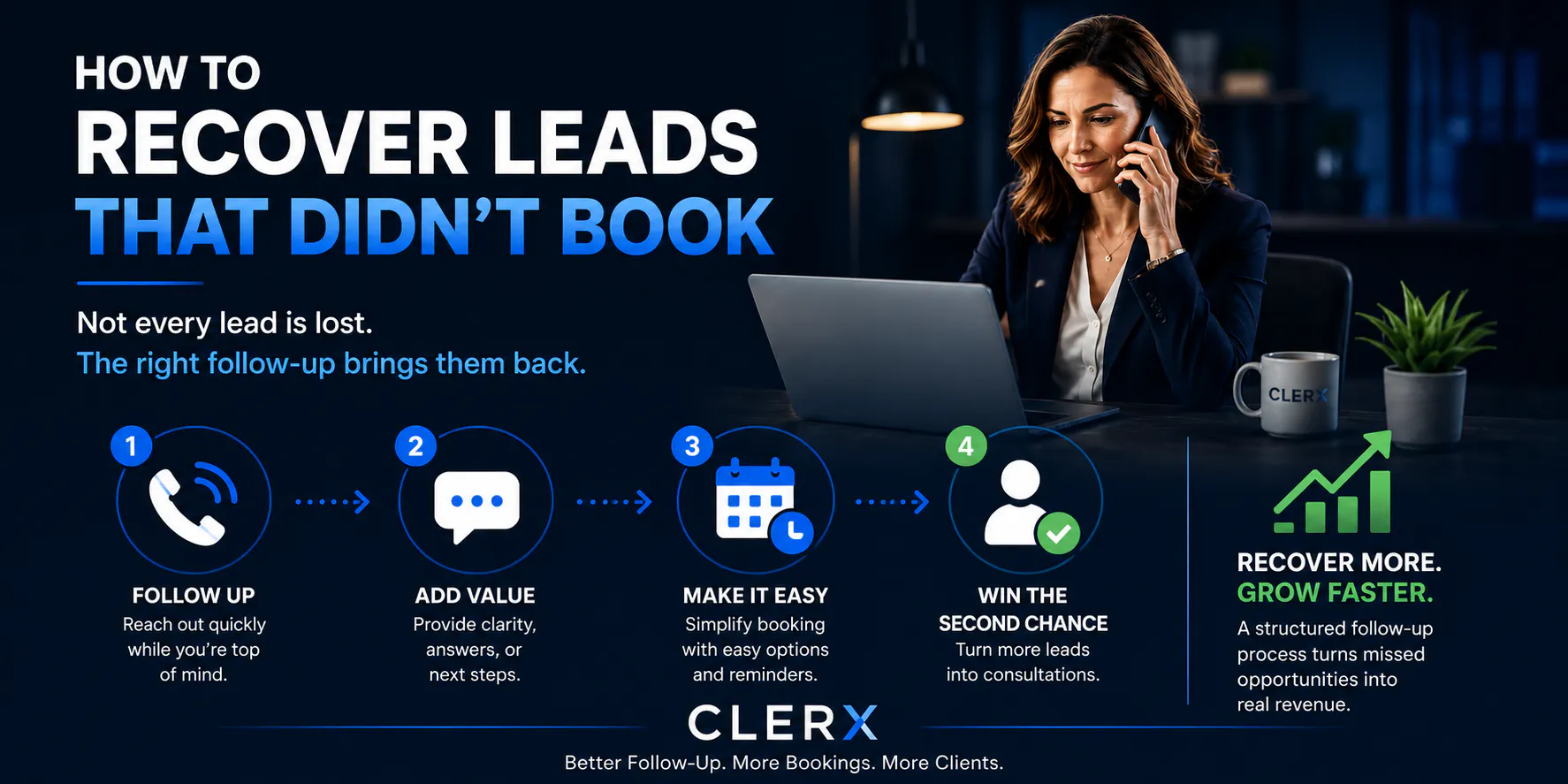
Most firms do not need aggressive follow-up. They need consistent follow-up.
A practical recovery workflow might include:
The tone should be helpful, not pushy.
The goal is to make it easy for the person to re-engage, not to pressure them. A good follow-up should remind the prospect why they reached out, clarify the next step, and reduce the work required to move forward.
For example, instead of saying, “Just checking in,” a stronger follow-up might say:
“We wanted to make sure you still had a clear next step. If you would like to speak with the firm, you can book a consultation here, or reply with a better time and we can help coordinate.”
That kind of message is practical, clear, and respectful.
If a lead did not book the first time, the second attempt should be easier, not harder.
That means the firm should avoid forcing the person to repeat the full intake conversation. The follow-up should use what the firm already knows and guide the prospect to one obvious next step.
Common recovery friction includes:
Every extra step gives the lead another chance to drop off.
This is where consultation booking, follow-up, and intake design overlap. A firm’s recovery process should be connected to its broader intake workflow, not handled as an afterthought.
Different leads respond to different channels.
Phone can work well when the prospect previously called and seemed urgent. Text can work well for quick booking nudges and reminders. Email can work well when the follow-up includes more detail or a checklist.
The key is ownership. The firm should know:
When no one owns the second touch, recovery becomes inconsistent.
This is also where system design matters. Posts like Can MyCase Automate Client Communication? What Law Firms Should Automate - and What Still Needs an Intake Layer, The Intake Layer: How Lawcus Users Turn More Leads Into Matters, and The Intake Layer: How Filevine Users Turn More Leads Into Matters all point to the same issue: follow-up works best when it is part of the intake layer, not a disconnected manual task.
If the firm does not track unbooked leads, it cannot improve lead recovery.
At minimum, firms should measure:
This is where lead recovery becomes a management discipline rather than a staff reminder.
If a meaningful percentage of consultations are booked only after the second or third touch, that follow-up process is not optional. It is part of revenue operations.
Recovery workflows can be structured and partly automated, but judgment still matters.
Human review is important when:
The purpose of automation is not to replace careful judgment. It is to make sure good leads do not vanish simply because no one remembered to follow up.
Clerx helps law firms strengthen intake and communication across calls, website chat, and SMS so more leads receive a timely, structured, and consistent path forward.
Donna helps firms respond quickly, collect useful intake details, support consultation movement, and reduce the manual gaps that cause viable leads to go quiet after first contact.
If you want to see how this could work inside your firm using your current systems, book a short demo here.
Yes. Many unbooked leads are still viable. They may need more clarity, a simpler scheduling path, or a second touch before they are ready to move forward.
A practical starting point is two to three follow-up attempts, spaced over several days. The exact cadence should depend on urgency, practice area, and how interested the lead seemed.
It should remind the prospect of the next step, make booking easy, and reduce confusion. The tone should be helpful and clear, not pushy.
A lead can usually be marked inactive after the firm has made a reasonable number of follow-up attempts and the prospect has not responded, unless the matter has a specific future timing trigger.
Yes. AI can help send timely follow-up, support text or chat re-engagement, remind prospects of next steps, and reduce the chance that viable leads disappear because the team got busy.
Attorney Michael Brunman, is the Co-Founder and CEO of Clerx. He is a former commercial and intellectual property litigator, Harvard MBA ’23, former PayPal product manager, and former McKinsey consultant. At Clerx, he helps law firms use AI agents to improve client intake, reduce missed calls, and streamline client communication.
6/12/2026
Text messaging can improve speed and convenience, but only if the firm treats SMS as part of intake instead of a disconnected side channel.
6/11/2026
Website chat can improve law firm conversions, but only when it helps visitors move forward instead of adding another disconnected intake step.
We use cookies to ensure you get the best experience on our website. For more information, please see our Privacy Policy.
