6/8/2026
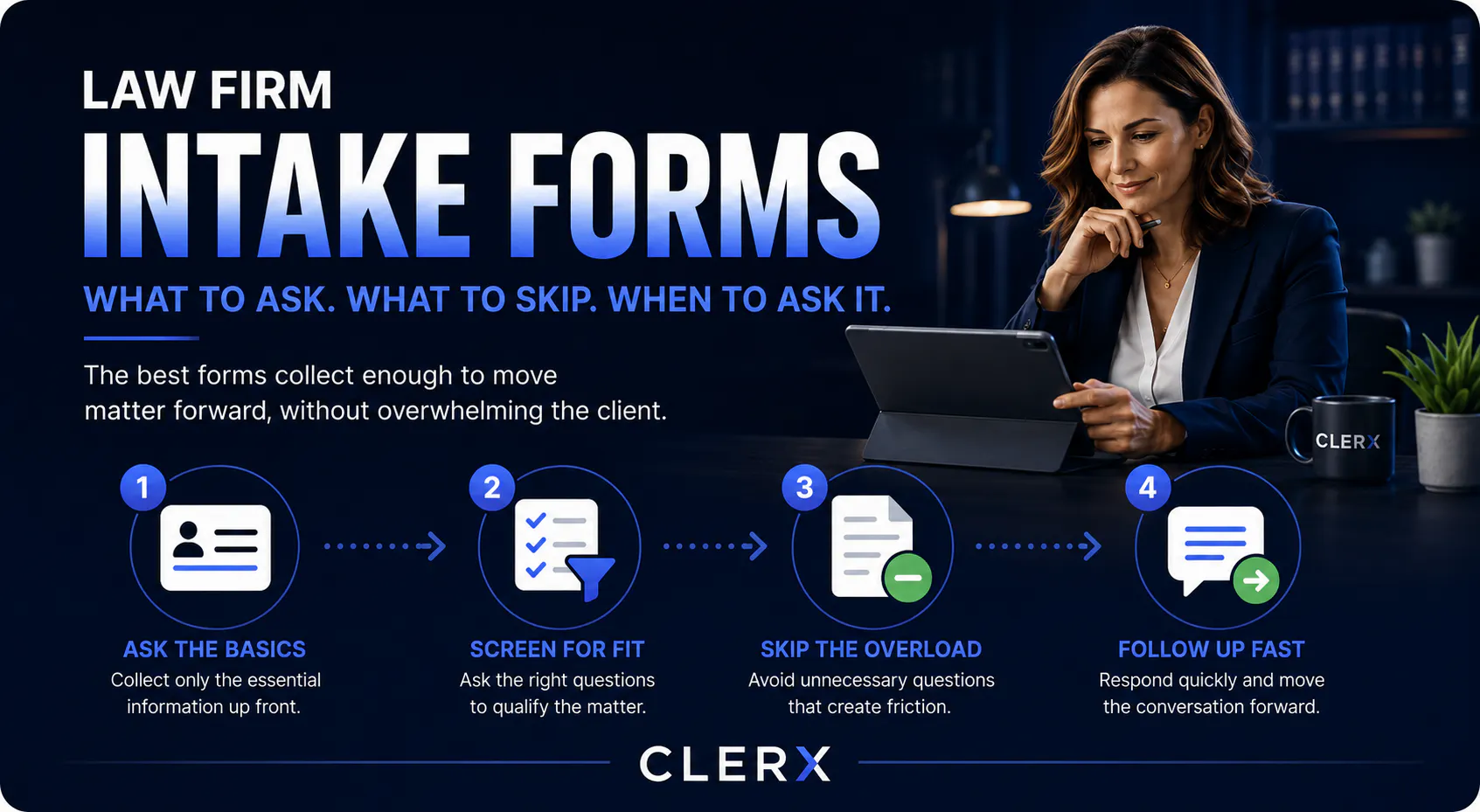
The best intake forms gather enough information to move the matter forward without overwhelming the prospective client before trust is built.
By Attorney Michael Brunman, Co-Founder & CEO of Clerx
Many law firms know they need intake forms, but fewer firms design those forms around the client journey.
Some forms ask too little. The firm receives a name, phone number, and vague description, then staff have to chase the basics later. Other forms ask too much too early. The prospective client is asked for detailed facts, documents, timelines, and sensitive information before they even know whether the firm can help.
Both approaches create friction.
A strong law firm intake form should do one main job: collect enough information to move the inquiry to the right next step.
It should not replace the consultation. It should not overwhelm the client. It should not create busywork for staff. And it should not sit disconnected from the rest of the firm’s intake workflow.
That is why intake forms belong in the same broader conversation as Why Intake Is More Than a Phone Function: It Is a Law Firm Growth System, What Is a Good Intake Call for a Law Firm? Best Practices to Improve Client Conversion, The Complete Guide to Perfecting Law Firm Intake in 2026, and Law Firm Intake Checklist for 2026: 25 Things Every Intake Workflow Should Cover.
An intake form is not just a digital questionnaire.
It is part of the firm’s first impression. It helps the firm understand who is reaching out, what they need, whether the matter may fit, and what should happen next.
A good intake form should help answer a few practical questions:
That is enough for the first step.
The mistake many firms make is trying to use the first intake form as a full legal interview. That often creates drop-off, especially for stressed, confused, or mobile users who just want to understand whether the firm can help.
Most law firm intake forms should begin with a simple core section.
That usually includes:
These questions are simple, but they are powerful. They allow the firm to respond quickly, route the inquiry properly, and avoid wasting time on incomplete submissions.
This basic structure also supports the response-speed principles discussed in How Fast Should a Law Firm Respond to New Leads? Benchmarks for Calls, Forms, Chat, and Text, The Hidden Cost of Missed Calls: How Law Firms Lose Revenue Before Intake Even Begins, and The After-Hours Gap: Why Law Firms Lose Clients After 5 PM (and How to Fix It). A form only helps if someone responds to it quickly and clearly.
Some questions are important, but they do not always belong on the first form.
These may include:
These details may matter later. But asking for them too early can create unnecessary friction.
The first form should help the firm decide whether and how to engage. Deeper information can be collected after the person has been routed properly, scheduled, or confirmed as a likely fit.
This is especially important in consumer-facing practice areas where prospects may already feel anxious or overwhelmed. For example, a personal injury caller, immigration client, family law prospect, or bankruptcy lead may need a guided process before they are ready to complete a long form.
Some form fields should be avoided unless the firm has a clear reason to use them.
Avoid questions that are:
Every field should earn its place.
If no one on the team uses a field to route, qualify, schedule, prepare, or follow up, it probably should not be on the first form.
This is where forms connect directly to intake quality. A form that collects irrelevant information may look thorough, but it does not improve conversion or workflow.
A firm may need more than one intake form.
The first-contact form should be short and focused. A pre-consultation form can be more detailed. A new-client onboarding form can collect even more information after engagement.
That staged approach usually works better than one long form that tries to do everything at once.
A practical structure might look like this:
This approach helps the firm reduce friction while still collecting the right information at the right time.
It also aligns with the broader workflow issues discussed in Why Legal Consultations Don’t Get Booked: 10 Intake Leaks Between First Contact and Calendar, How to Recover Leads That Didn’t Book on the First Interaction, and Law Firm Intake Metrics That Actually Matter: The Dashboard Every Managing Partner Should Review.
A common mistake is treating intake forms as storage tools.
The real question is not whether information was collected. The real question is whether the information triggered the right next action.
A strong intake form should connect to a workflow. For example:
Without action rules, even a well-designed form can become a dead end.
This is why intake forms should connect to the firm’s broader systems. The same intake-layer logic appears in Practice Management Software vs Intake Software: What Each Should Actually Handle, Can MyCase Automate Client Communication? What Law Firms Should Automate - and What Still Needs an Intake Layer, The Intake Layer: How Lawcus Users Turn More Leads Into Matters, and The Intake Layer: How Filevine Users Turn More Leads Into Matters.
The best intake form is not always the most comprehensive one. It is the one the right prospects actually complete.
To reduce friction:
That final point matters. A form should not leave the prospect wondering whether anyone saw it. The confirmation should explain the next step clearly.
Forms can support screening, routing, and preparation, but they should not replace legal judgment.
The firm should still use human review for:
The form’s job is to create structure. The firm’s job is to apply judgment.
Clerx helps law firms strengthen intake and communication across calls, website chat, and SMS so the information collected from forms and other channels does not sit in isolation.
Donna helps firms respond faster, collect structured intake details, support consultation movement, and reduce the manual gaps that cause good leads to disappear.
If you want to see how this could work inside your firm using your current systems, book a short demo here.
At minimum, a first-contact form should collect name, phone, email, preferred contact method, practice area, short issue description, location, urgency, and whether the person wants to schedule a consultation.
If the form starts to feel like a full legal interview, it is probably too much for first contact. Detailed facts and documents can usually wait until after initial routing or consultation scheduling.
Yes. Basic jurisdiction, practice area, and urgency questions help the firm avoid wasting time and route inquiries more effectively.
Usually after the person has been identified as a potential fit, scheduled for a consultation, or moved into a pre-consultation workflow.
A strong form should not just collect information. It should trigger the right next step, such as follow-up, qualification, routing, or consultation scheduling.
Attorney Michael Brunman, is the Co-Founder and CEO of Clerx. He is a former commercial and intellectual property litigator, Harvard MBA ’23, former PayPal product manager, and former McKinsey consultant. At Clerx, he helps law firms use AI agents to improve client intake, reduce missed calls, and streamline client communication.
6/12/2026
Text messaging can improve speed and convenience, but only if the firm treats SMS as part of intake instead of a disconnected side channel.
6/11/2026
Website chat can improve law firm conversions, but only when it helps visitors move forward instead of adding another disconnected intake step.
We use cookies to ensure you get the best experience on our website. For more information, please see our Privacy Policy.
