6/4/2026
Most firms track either too much or too little, and the wrong metrics make intake problems harder to spot.
By Attorney Michael Brunman, Co-Founder & CEO of Clerx
A lot of law firms say they want to improve intake, but they are not actually measuring the parts of intake that drive growth.
They may know roughly how many calls came in last month. They may have a sense that the staff feels busy. They may know how many consultations happened. But when something goes wrong, such as too many missed opportunities, weak conversion, or inconsistent first response, the diagnosis is often vague.
That is where intake metrics matter.
The right intake dashboard helps a managing partner see whether the firm is:
This is why intake measurement belongs in the same broader conversation as Why Intake Is More Than a Phone Function: It Is a Law Firm Growth System, The Complete Guide to Perfecting Law Firm Intake in 2026, The Law Firm Marketing Funnel: How to Turn More Leads Into Clients, and Legal Marketing in 2026: Why Visibility Alone No Longer Wins Clients. A firm cannot improve what it does not measure clearly.
The problem is usually not that firms have no data. It is that they focus on the wrong data.
Some firms track too much:
Other firms track too little:
Neither approach is very helpful.
A better intake dashboard focuses on a small set of numbers that tell a managing partner where the workflow is healthy and where it is leaking value. The goal is not reporting for reporting’s sake. The goal is operational clarity.
That same need for clarity also sits behind The Hidden Cost of Poor Communication for Small & Midsize Law Firms, Why Law Firms Get Ghosted and How to Fix It, and How AI Intake Helps Law Firms Scale Without Adding Overhead. These are all, at their core, measurement problems as much as workflow problems.
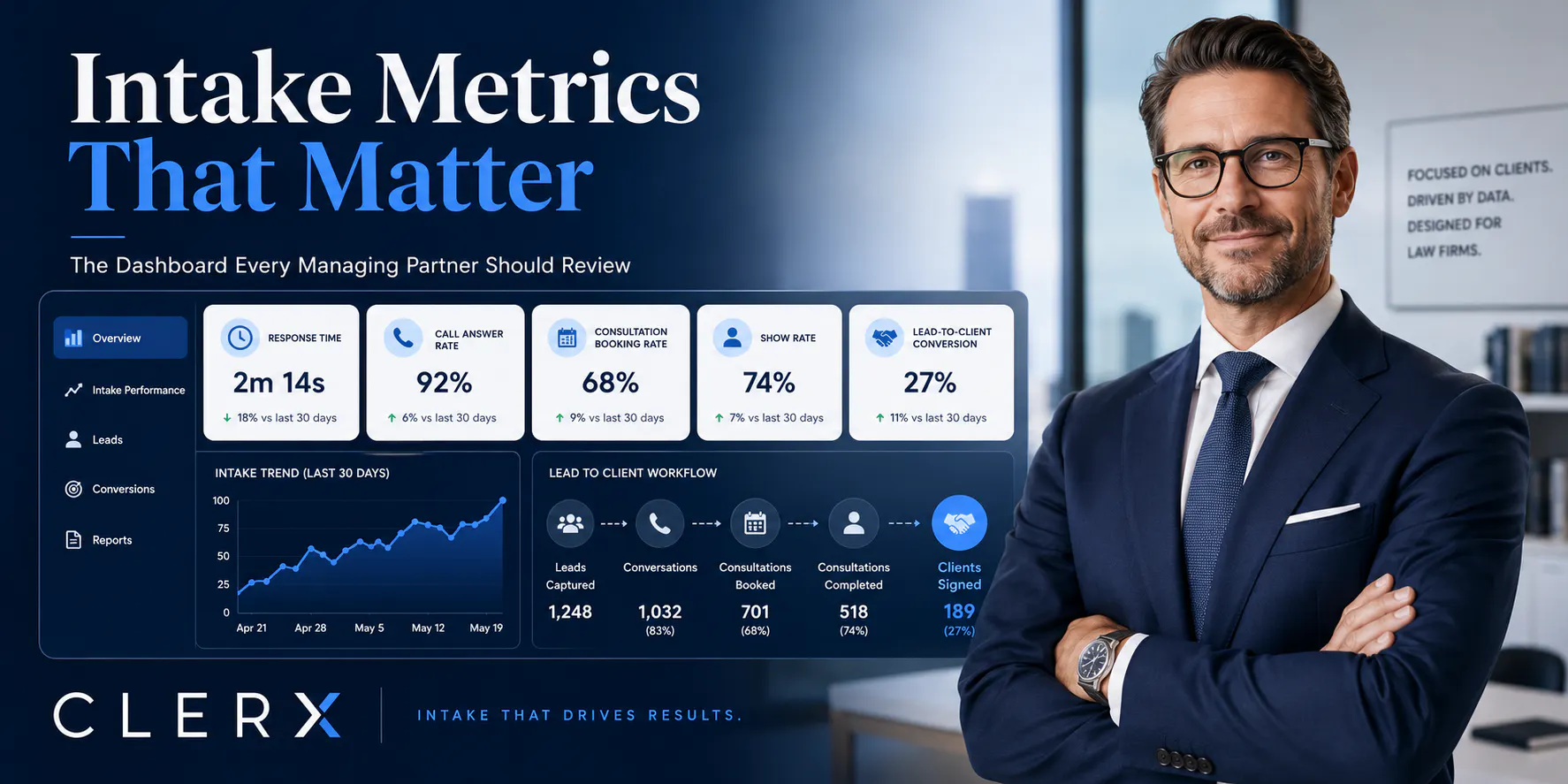
This is one of the most important intake metrics a firm can track.
It answers a simple question: after a lead calls, fills out a form, opens chat, or sends a text, how long does it take the firm to respond meaningfully?
If that number is too high, almost everything downstream gets weaker.
This metric also connects directly to The Hidden Cost of Missed Calls: How Law Firms Lose Revenue Before Intake Even Begins, The After-Hours Gap: Why Law Firms Lose Clients After 5 PM (and How to Fix It), and Legal Answering Services in 2026: Which Option Is Right for Your Practice?. If response is slow, conversion suffers long before the consultation stage.
If your firm depends on phone-based inquiries, answer rate should be on the dashboard.
This is not just a receptionist metric. It is a revenue-protection metric. A missed call may represent a missed consultation, and in some firms that means a missed matter.
The answer rate should ideally be broken out by:
That makes it easier to see whether the real problem is staffing, timing, or process design.
Not every inquiry should move forward. That is why total lead volume is not enough.
A stronger dashboard tracks how many raw inquiries become qualified leads. That number helps a firm understand:
This is one of the best ways to connect intake quality with growth quality.
This is one of the clearest measures of whether intake is moving leads forward.
If inquiry volume looks healthy but consultation booking is weak, the gap is often in first response, qualification, next-step clarity, or scheduling friction.
This metric should be reviewed alongside What Is a Good Intake Call for a Law Firm? Best Practices to Improve Client Conversion, Why Legal Consultations Don’t Get Booked: 10 Intake Leaks Between First Contact and Calendar, and How AI Intake Helps Law Firms Scale Without Adding Overhead.
Getting the appointment on the calendar is not the same as completing it.
A strong intake dashboard should show whether booked consultations actually happen. Weak show rates often point to:
This is one reason consultation metrics should be treated as part of intake, not a separate downstream issue.
This is where intake finally connects to business outcomes.
A firm should know how many inquiries become clients, but it should not stop there. It should also understand that this number is influenced by multiple intake-stage variables:
That is why lead-to-client conversion is a useful summary metric, but not enough on its own. It tells you there is a problem. It does not tell you where.
This is one of the most underrated metrics.
How often do attorneys or staff receive incomplete intake context before a consultation or next step? If that number is high, the firm is paying hidden admin costs through:
This is where intake operations start to affect not just conversion, but overall workflow quality.
A managing partner should know whether calls, forms, chat, or text are producing the best outcomes.
This matters because firms often invest in channels without understanding which ones actually lead to consultations and signed clients.
A good dashboard should make it possible to compare:
That is one of the clearest ways to connect intake performance with marketing efficiency.
A useful intake dashboard does not need twenty tabs. For most firms, the best managing-partner view includes:
That is enough to reveal whether the front end of the client journey is healthy.
It also helps to review trends, not just snapshots. One weak week can happen. A repeated decline in booking rate or response speed is a signal.
Clerx helps law firms strengthen intake and communication across calls, website chat, and SMS so firms can respond faster, qualify more consistently, and create cleaner visibility into what is happening at the front end of the client journey.
That matters because the best dashboard is only useful if the underlying workflow is strong enough to improve.
If you want to see how this could work inside your firm using your current systems, book a short demo here.
For most firms, time to first response is one of the most important because it influences consultation booking and overall conversion.
There is no universal number, because it depends on practice area, source quality, and how qualification is defined. What matters is whether the rate is improving and whether it lines up with the quality of leads coming in.
At minimum, firms should track total calls, answer rate, missed-call rate, and callback timing. Breaking those numbers out by business hours and after hours is even more useful.
There is no single perfect measure, but intake completeness rate and inquiry-to-qualified-lead rate are two of the best for showing whether the process is structured and usable.
At least monthly for trend review, and ideally weekly for core metrics like response speed, booking rate, and missed-call performance.
Attorney Michael Brunman, is the Co-Founder and CEO of Clerx. He is a former commercial and intellectual property litigator, Harvard MBA ’23, former PayPal product manager, and former McKinsey consultant. At Clerx, he helps law firms use AI agents to improve client intake, reduce missed calls, and streamline client communication.
6/12/2026
Text messaging can improve speed and convenience, but only if the firm treats SMS as part of intake instead of a disconnected side channel.
6/11/2026
Website chat can improve law firm conversions, but only when it helps visitors move forward instead of adding another disconnected intake step.
We use cookies to ensure you get the best experience on our website. For more information, please see our Privacy Policy.
