6/2/2026
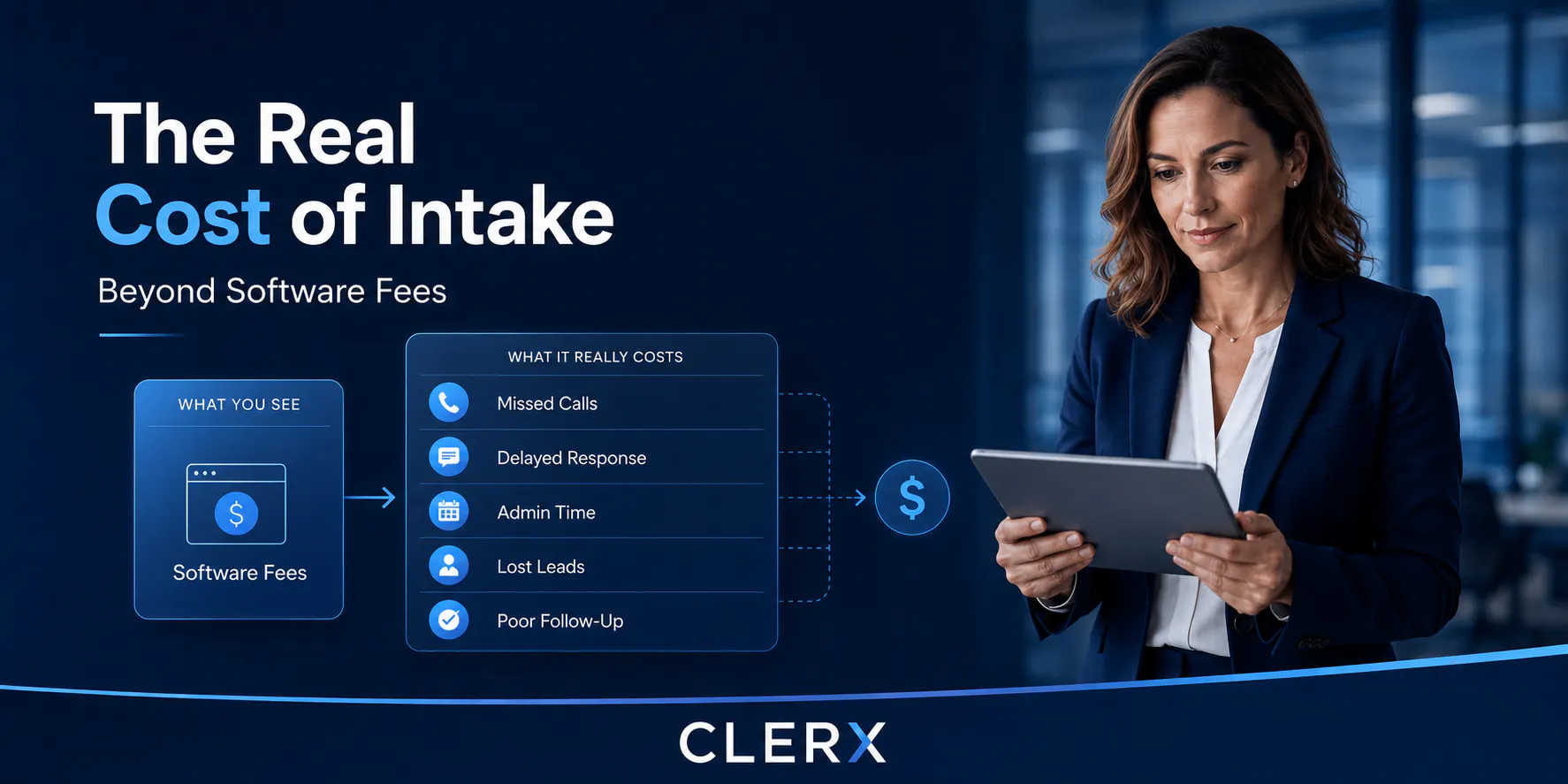
The real cost of intake software is not just the monthly subscription. It is how much missed demand, manual work, and conversion leakage your firm is still carrying without it.
By Attorney Michael Brunman, Co-Founder & CEO of Clerx
A lot of law firms ask the wrong first question when thinking about intake software.
They ask, “How much does it cost?”
That matters, of course. But it is only part of the picture.
A better question is: what is the firm already paying for slow response, missed calls, inconsistent qualification, scattered follow-up, and wasted attorney time?
That is where the real economics of intake software start.
In 2026, law firms are not just comparing tools. They are comparing operating models. They are weighing whether their current intake process is strong enough to protect the demand they already generate and whether the front end of the client journey is helping growth or quietly holding it back.
This is why intake software belongs in the same broader conversation as Why Intake Is More Than a Phone Function: It Is a Law Firm Growth System, The Complete Guide to Perfecting Law Firm Intake in 2026, The Hidden Cost of Missed Calls: How Law Firms Lose Revenue Before Intake Even Begins, and How AI Intake Helps Law Firms Scale Without Adding Overhead.
When firms think about intake software cost, they usually focus on the visible line item: subscription price.
That is understandable, but it misses the larger expense categories that already exist in most firms:
In other words, firms are already paying for intake. They are just often paying for it inefficiently.
This is also why intake economics connect directly to Legal Marketing in 2026: Why Visibility Alone No Longer Wins Clients and The Law Firm Marketing Funnel: How to Turn More Leads Into Clients. A firm can spend on visibility all month long and still lose value if the intake layer is weak.
Most firms evaluating intake software are really deciding between three types of cost.
This includes reception coverage, intake staff, callback burden, scheduling coordination, and administrative follow-up.
Even in firms with strong people, a surprising amount of time goes into repetitive first-response work that does not require legal judgment but still needs to happen reliably.
This is the cost firms usually undercount.
It includes missed calls, delayed response, weak booking flow, no-show friction, and dropped leads that were likely viable but never moved forward. This is where the cost of weak intake becomes much larger than the monthly software fee.
That same problem is explored in Why Law Firms Get Ghosted and How to Fix It, The After-Hours Gap: Why Law Firms Lose Clients After 5 PM (and How to Fix It), and Legal Answering Services in 2026: Which Option Is Right for Your Practice?.
This is the cost of bad handoffs, incomplete intake notes, poor qualification, duplicated data entry, and consultations that begin without enough context.
Firms often do not budget for this category explicitly, but they feel it every week.
Intake software pricing usually depends on a few practical variables:
That is why pricing varies. A simple system for basic call capture is not the same as a structured intake layer that supports qualification, scheduling, follow-up, and cleaner handoff into the rest of the firm’s operations.
This is also where firms sometimes confuse categories. Practice-management systems and intake systems do related work, but not the same work. That distinction matters in Can MyCase Automate Client Communication? What Law Firms Should Automate - and What Still Needs an Intake Layer, The Intake Layer: How Lawcus Users Turn More Leads Into Matters, and The Intake Layer: How Filevine Users Turn More Leads Into Matters.
Instead of asking only whether intake software is expensive, firms should ask:
If the answer to those questions is yes, the right comparison is usually not software cost versus zero. It is software cost versus the cost of continuing to leak value every month.
That is why intake ROI is often strongest in firms that already have healthy inquiry flow but weak conversion discipline. Those firms do not always need more leads first. They often need better response and better structure.
Law firms usually overpay in one of two ways.
The first is paying for labor-heavy intake work that could be structured more efficiently.
The second is paying for marketing while underinvesting in the system that captures the results of that marketing.
This is where software can help, but only if it actually improves the process. A tool that adds another disconnected workflow is not really saving money. A tool that makes response faster, qualification cleaner, and booking easier is much more likely to create real economic value.
Clerx helps law firms strengthen intake and communication across calls, website chat, and SMS so firms can respond faster, qualify more consistently, and move more viable prospects toward consultation.
Donna helps reduce missed-opportunity cost and workflow-friction cost by improving first response, structured intake, scheduling support, and follow-up, without replacing legal judgment.
For firms already using other legal systems, the value is often strongest when intake connects cleanly to the rest of the workflow. That is why it helps to review how Clerx fits with tools and workflows firms already rely on through the Book a Demo path and related workflow content.
Law firm intake software cost is not just a budgeting question. It is an operating-model question.
The right system should not simply add a new monthly fee. It should reduce drag, protect demand, improve conversion, and make the front end of the client journey more reliable.
That is how firms should think about cost in 2026.
Usually it is missed-opportunity cost. Firms often notice staffing expense first, but the more expensive problem is lost consultations and dropped leads that never become matters.
It can be both, but for many firms it is more accurately a conversion and growth tool. It helps the firm get more value from inquiries it is already generating.
The biggest drivers are inquiry volume, supported channels, workflow complexity, integrations, multilingual needs, after-hours handling, and how much of the intake process the system is expected to support.
A useful way to think about ROI is to compare software cost against the cost of missed calls, slow response, wasted attorney time, weak qualification, and lost booking opportunities.
Usually when the firm already has demand but can see signs of intake friction, such as missed calls, delayed response, inconsistent screening, weak consultation booking, or follow-up that depends too heavily on manual effort.
Attorney Michael Brunman, is the Co-Founder and CEO of Clerx. He is a former commercial and intellectual property litigator, Harvard MBA ’23, former PayPal product manager, and former McKinsey consultant. At Clerx, he helps law firms use AI agents to improve client intake, reduce missed calls, and streamline client communication.
6/12/2026
Text messaging can improve speed and convenience, but only if the firm treats SMS as part of intake instead of a disconnected side channel.
6/11/2026
Website chat can improve law firm conversions, but only when it helps visitors move forward instead of adding another disconnected intake step.
We use cookies to ensure you get the best experience on our website. For more information, please see our Privacy Policy.
