6/4/2026
Many law firms expect practice management software to solve first-response problems it was never designed to own.
By Attorney Michael Brunman, Co-Founder & CEO of Clerx
A lot of law firms have invested in software but still feel frustrated by missed leads, slow response, weak handoffs, and inconsistent first contact.
That usually happens for one simple reason: the firm bought a strong system for managing matters, but it still has a weak system for managing what happens before a matter exists.
This is where many law firms get confused.
Practice management software and intake software are related, but they are not the same thing. They sit in different parts of the client journey, solve different operational problems, and create value in different ways. When firms blur the line between them, they often expect one platform to do work it was never meant to handle.
That is why this topic belongs in the same broader conversation as Why Intake Is More Than a Phone Function: It Is a Law Firm Growth System, The Complete Guide to Perfecting Law Firm Intake in 2026, What Is a Good Intake Call for a Law Firm? Best Practices to Improve Client Conversion, and The Law Firm Marketing Funnel: How to Turn More Leads Into Clients.
A useful way to think about it is this:
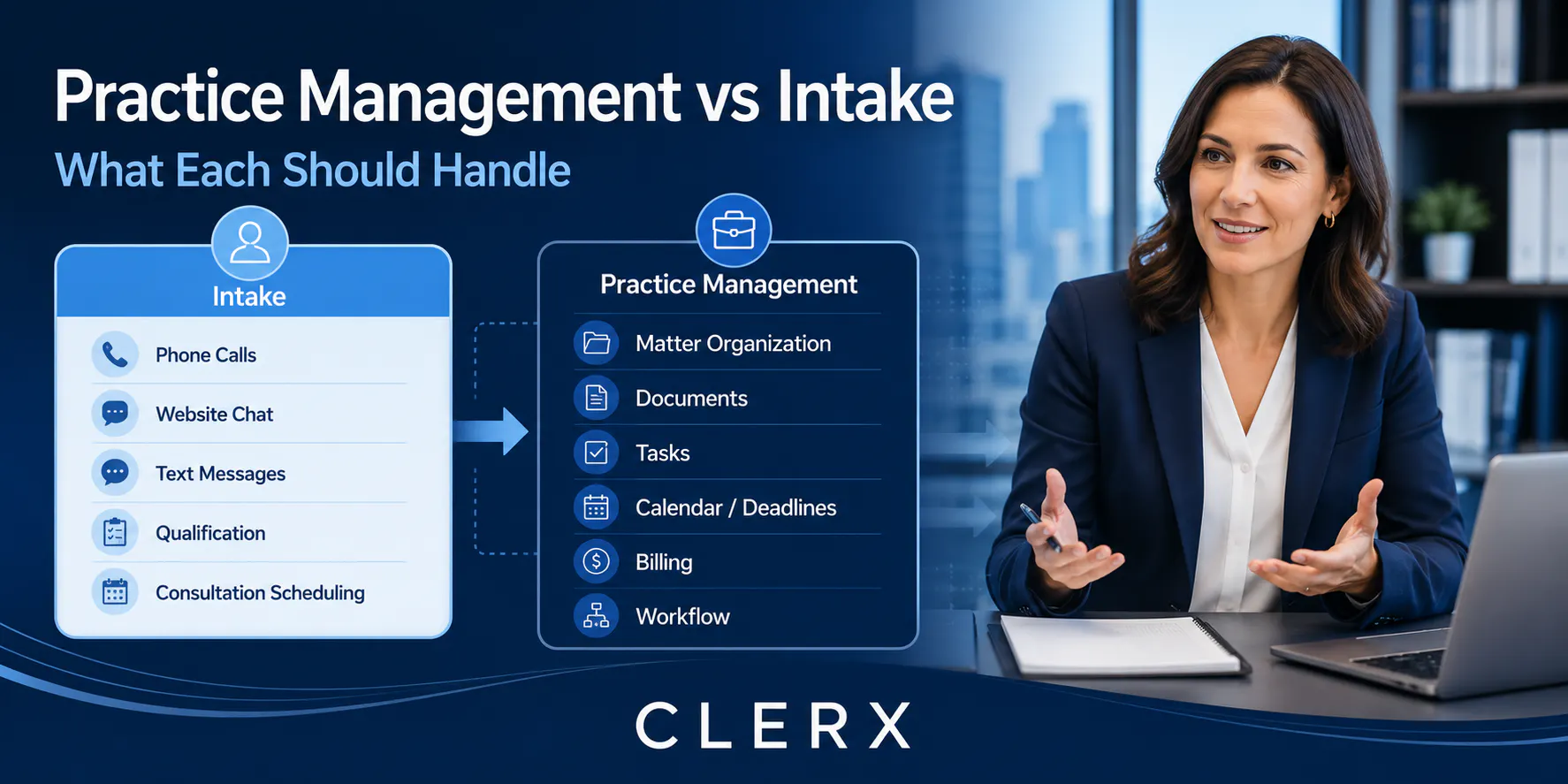
Intake software helps the firm capture, qualify, and move inquiries forward.
Practice management software helps the firm manage work once the matter is underway.
That distinction sounds simple, but it has major operational consequences.
If a potential client calls the firm, submits a form, opens a chat, or sends a text, the firm is still in the intake stage. The core questions are:
Once that person becomes a real client or active matter, a different set of questions takes over:
Those are different jobs.
Practice management software is the operating system for active work.
It is typically strongest at things like:
This is the layer firms rely on once the legal work is actually in motion.
That is why practice management software is so valuable. It creates structure, visibility, and accountability after the firm has already decided to move forward with a lead or open a matter.
But practice management software is usually not designed to be the firm’s full first-response system. It does not automatically mean the firm is fast at answering calls, consistent in qualification, or strong at moving an inquiry from first touch to booked consultation.
That gap is exactly where many firms lose value.
Intake software should own the front end of the client journey.
That usually includes:
In other words, intake software helps the firm manage uncertainty, speed, and conversion before legal work begins.
This is why How AI Intake Helps Law Firms Scale Without Adding Overhead, The Hidden Cost of Missed Calls: How Law Firms Lose Revenue Before Intake Even Begins, Why Law Firms Get Ghosted and How to Fix It, and The After-Hours Gap: Why Law Firms Lose Clients After 5 PM (and How to Fix It) matter so much. They are all really describing failures in the intake layer, not failures in case management.
The gap usually appears when a law firm assumes that because it has practice management software, it has solved intake.
That assumption creates a few common problems:
The firm has a strong internal workflow, but no strong system for calls, forms, chat, or text when a new lead first reaches out.
The lead enters the workflow with incomplete context because no one defined a structured first-response process.
The consultation booking step sits outside the real intake system, so good leads stall between interest and calendar.
Calls, texts, forms, and chat messages are not part of one front-end workflow, so the lead experiences the firm as disconnected.
The attorney or team member receiving the matter still has to chase basics because the intake stage did not gather and organize enough useful information.
That is why firms often feel that their software should be helping more than it is. The issue is not always that the platform is weak. The issue is that the intake layer before it is weak.
This is not just a software-architecture issue. It is a growth issue.
A firm can invest in good marketing, strong reputation, local SEO, paid search, or referrals, and still lose too many opportunities if the front end of the client journey is not built properly.
That is why this topic connects directly to Legal Marketing in 2026: Why Visibility Alone No Longer Wins Clients, Mastering Owned Media for Law Firms in 2026, and The Hidden Cost of Poor Communication for Small & Midsize Law Firms.
Practice management software helps the firm manage the work it has.
Intake software helps the firm capture more of the work it should have had in the first place.
The healthiest way to think about legal software is not as one giant system that should do everything equally well. It is as connected layers.
This layer handles:
This layer handles:
When firms get these two layers right, the whole client journey becomes cleaner.
That is also why system-specific posts on the Clerx blog keep returning to the same theme:
The pattern is consistent across platforms. Good practice-management systems still benefit from a stronger intake layer in front of them.
Even with stronger intake technology, some parts of the process should remain clearly human-led.
These include:
That boundary matters.
The purpose of intake software is not to replace legal judgment. It is to make the path from inquiry to consultation cleaner, faster, and more consistent so human judgment gets used where it matters most.
Clerx helps law firms strengthen the intake and communication layer across calls, website chat, and SMS so firms can respond faster, qualify more consistently, and move more viable prospects toward consultation.
That makes practice management systems more useful, not less useful, because the information entering the workflow is cleaner and the front end of the client journey is less fragile.
For firms already using legal software, it helps to look at how Clerx fits into those existing workflows through pages like Lawcus Integration, along with broader intake-layer articles that show how firms can connect first response to the systems they already rely on.
If you want to see how this could work inside your firm using your current systems, book a short demo here.
Practice management software and intake software should not be treated as interchangeable.
One helps the firm manage legal work.
The other helps the firm capture and convert opportunities before legal work begins.
The firms that understand that distinction usually build cleaner workflows, stronger response systems, and more reliable growth.
Practice management software is built to manage active matters and internal legal workflow. Intake software is built to manage first response, qualification, scheduling, and movement from inquiry to consultation.
Because many firms have strong systems for managing work after a matter exists, but weak systems for managing calls, forms, chat, text, and qualification before the matter exists.
Yes. Intake should usually happen before the matter-management workflow, because the firm still needs to assess fit, collect core information, guide the next step, and move the lead toward consultation.
Lawcus can be a strong system for managing leads, workflows, and matters, but firms still benefit from a clean intake layer that improves first response, qualification, and handoff before those workflows fully begin.
Usually when it sees signs like missed calls, slow response, inconsistent screening, booking friction, weak handoffs, or too much manual effort between inquiry and consultation.
Attorney Michael Brunman, is the Co-Founder and CEO of Clerx. He is a former commercial and intellectual property litigator, Harvard MBA ’23, former PayPal product manager, and former McKinsey consultant. At Clerx, he helps law firms use AI agents to improve client intake, reduce missed calls, and streamline client communication.
6/12/2026
Text messaging can improve speed and convenience, but only if the firm treats SMS as part of intake instead of a disconnected side channel.
6/11/2026
Website chat can improve law firm conversions, but only when it helps visitors move forward instead of adding another disconnected intake step.
We use cookies to ensure you get the best experience on our website. For more information, please see our Privacy Policy.
